
📑 Table of Contents
- Pandharpur is a pilgrimage first; the car is only the road plan
- Why devotees make the journey
- Check official booking information for your date
- Wari and Ekadashi: plan for uncertainty
- Mumbai–Pandharpur road planning: keep driving and darshan separate
- Before departure: visitor and service checks
- Prepare a clear enquiry
- Frequently asked questions
- Can HeliosCabs book Vitthal-Rukmini darshan or Token Darshan passes?
- What did the Samiti portal say about Token Darshan and Kartiki Yatra?
- Is Pandharpur suitable during Wari?
- Can I plan the Mumbai–Pandharpur journey as a single driving day?
- Are parking, waiting or a local Pandharpur car included?
- What should an overseas visitor check?
- Plan the road journey around the temple’s rules
- Sources and further reading
- Plan your Mumbai-origin journey with the right checks
Pandharpur is a pilgrimage first; the car is only the road plan
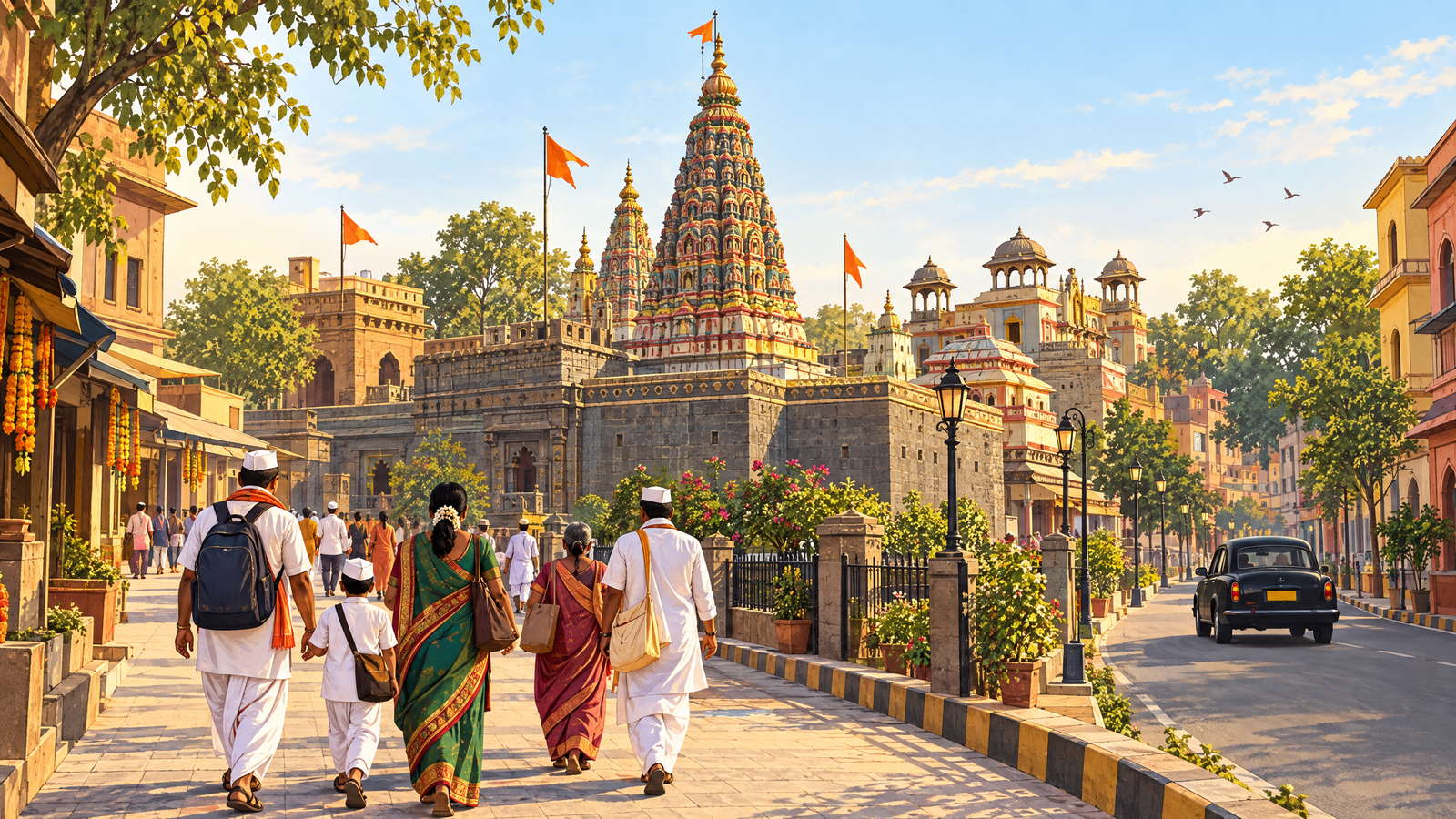
Shri Vitthal-Rukmini Mandir makes Pandharpur an important centre of Maharashtra’s devotional life. The town is closely associated with the Wari, when Warkari pilgrims walk to Pandharpur in the Ashadh and Kartik seasons. For a family travelling from Mumbai, keep three decisions separate: the temple committee’s darshan and pilgrim services, festival-day arrangements in town, and the chauffeur journey to and from Pandharpur.
A Mumbai-origin chauffeur-driven car can support the road itinerary, subject to route, vehicle and booking confirmation. It cannot book or guarantee darshan, issue a token, provide priority access, or promise parking or driver waiting. Those matters are controlled by the temple committee and local authorities. Start with the official Shri Vitthal-Rukmini Mandir website and the official Samiti online booking portal; do not rely on an agent or an unofficial booking page for temple services.
Why devotees make the journey
The shrine is dedicated to Vitthal, also known as Vithoba, and Rukmini. Maharashtra Tourism’s Pandharpur overview describes the town’s setting on the Chandrabhaga River and its Wari pilgrimage. In devotional tradition, the story of Pundalik explains Vitthal’s standing posture on a brick; this is a religious tradition, not a claim of independently verified history. Palkhi processions, abhang singing and the foot pilgrimage are central to the town’s identity. For many visitors, the significance is not only reaching the sanctum but encountering a living Bhakti tradition.
A visit can also be meaningful outside peak yatra periods. A less crowded date may be easier for some families to plan, but it does not guarantee a short queue or a particular darshan format. If your purpose is a specific aarti, puja, Pad Sparsh Darshan or another service, check its availability and rules with the committee for your date before arranging transport or accommodation.
Check official booking information for your date
The Samiti portal identifies itself as the official booking website and says the committee does not authorize agents for online darshan, accommodation or puja bookings. When checked on 10 November 2026, the portal said Indian devotees could use a valid Indian mobile number and OTP, while foreign users could book using a valid email address and OTP. NRIs and overseas visitors should follow the portal’s instructions shown at the time of booking and contact the committee if a requirement is unclear. Do not share passwords, OTPs or card-security details with an agent.
The booking information visible on 10 November 2026 said Token Darshan passes could be booked up to 10 days before the darshan date, but were not available on yatra days, festivals or Ekadashi. A separate notice displayed on that date said online services—including advance Pad Sparsh Darshan and Bhakt Nivas room bookings—would be suspended from 10 to 25 November 2026 for Kartiki Yatra 2026. This records what the portal displayed when checked; it is a time-limited notice, not a standing rule or confirmation of service availability on another date. Reopen the official portal for your exact travel date and follow any newer notice. If a token or service is unavailable, do not infer that walk-in tokens, paid access, an alternate arrangement or queue-free entry will be offered; ask the committee what applies.
Neither the temple website nor the booking portal confirms a private car’s approach, stopping or waiting arrangements, or how long darshan will take. Check local instructions close to travel and confirm the chauffeur service separately in writing with HeliosCabs.
Wari and Ekadashi: plan for uncertainty
Ashadhi and Kartiki Ekadashi periods bring exceptional pilgrimage activity. The Wari is a moving foot pilgrimage, not simply a one-day event at the temple entrance. Depending on the date and local arrangements, approach roads, movement within town, parking, drop-off points, queues and online pilgrim services may differ from an ordinary day. Maharashtra Tourism’s overview explains the Wari’s devotional significance; it is not a real-time traffic or access advisory.
For a Wari or Ekadashi visit, verify the calendar date and current temple and local-authority notices. Keep transport and accommodation plans flexible. Do not assume normal vehicle access, parking, driver waiting or token availability. A fixed onward connection may be risky unless arrangements are confirmed and your schedule can absorb delays.
Mumbai–Pandharpur road planning: keep driving and darshan separate
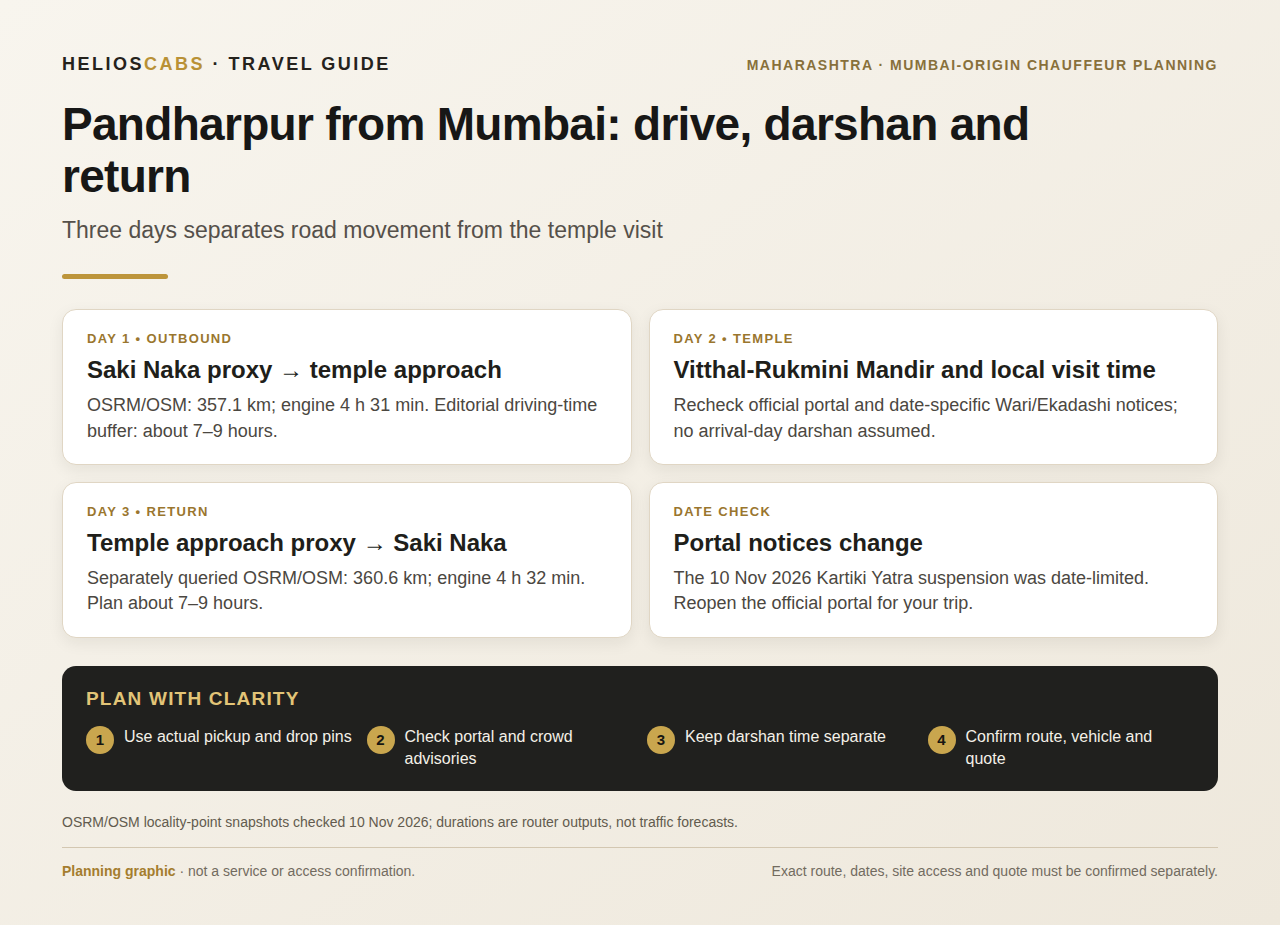
For orientation only, the route audit checked both directions separately on 10 November 2026. Its dated OSRM / OpenStreetMap snapshot used a Saki Naka locality proxy for the Mumbai/Aerocity Corporate Park area and a temple-approach proxy in Pandharpur. The outbound result was 357.1 km and about 4 hours 31 minutes of routing-engine time, with an alternate result of 356.3 km/4 hours 35 minutes; the separately queried return was 360.6 km and about 4 hours 32 minutes, with an alternate result of 359.8 km/4 hours 35 minutes. The outbound Google Maps query and return query are dynamic recheck links, not the source of those dated OSRM figures; their results may use different points or routes.
These are OSRM/OSM locality proxies, not exact Aerocity entrance, hotel, temple gate, parking bay or garage-to-garage points. They are free-flow routing-engine estimates, not live traffic guarantees or a quote distance. Actual movement may be longer because of the assigned pickup and garage, route choice, roadworks, traffic, breaks, local temple approach restrictions and Wari crowd controls. For conservative real-driving planning, allow about 7–9 hours per leg, and have Operations recheck both directions in Google Maps for the actual pickup, date and route before confirming a plan. The queries’ displayed distance and time are dynamic; record the timestamp and selected route if they are used operationally.
The dated proxy distances are below this guide’s 400-road-km editorial screen, and the estimated 7–9 driving hours per leg are below its 12-driving-hour editorial screen. These are planning aids only—not Helios policy or quote guarantees—and actual garage-inclusive movement may be longer. The evidence does not establish a suitable one-day arrival for every traveller or date and does not promise arrival in time for darshan. Keep darshan, queues, walking, meals and rest separate from intercity driving; the map results do not estimate them.
A useful starting framework is three calendar days and two nights, subject to an actual route and booking check:
- Day 1 — Mumbai towards Pandharpur: Travel by chauffeur-driven car with meal and rest breaks. Do not make a timed darshan commitment for arrival day. If the verified route—including required garage movement—would exceed either 400 road km or 12 driving hours on that calendar day, use this guide’s editorial planning screen to revise the plan and add a suitable overnight stop on a verified route rather than pressing on.
- Day 2 — Temple and Pandharpur: Keep this primarily for the temple and local devotional visits. Follow the committee’s instructions for any service you have confirmed and the day’s access conditions. Do not assume local vehicle access, parking or waiting.
- Day 3 — Pandharpur towards Mumbai: Treat the separately mapped return as its own driving day, with breaks. Check the live return query and actual route again; revise the staging if the verified route exceeds either 400 road km or 12 driving hours on that calendar day. Avoid adding another long excursion or fixing an onward connection unless Operations has reviewed the route and your schedule includes a delay buffer.
This is a conditional planning example, not a fixed package or promise of temple access. Recheck Wari, Yatra and Ekadashi dates, local access and traffic instructions, and the dated official portal suspension notice, before confirming. A festival, late start, mobility or rest need, road change, or verified leg above either 400 road km or 12 driving hours on a calendar day may require extra time and another night. These thresholds are editorial planning screens only, not binding Helios policy or quote guarantees. Have Operations check the actual route; where it allows, prefer about 325–350 road km per day. Count darshan, queues, walking, meals and rest separately as visitor time.
For a broader choice of shrines and circuits, see the Maharashtra pilgrimage circuits from Mumbai guide. The distinct Bhimashankar Jyotirlinga guide and Kolhapur Mahalaxmi–Jyotiba plan cover other destinations, not add-on stops for this Pandharpur plan. The existing Ashtavinayak Yatra chauffeur route guide is a separate pilgrimage resource.
Before departure: visitor and service checks
A few days before departure—and again near a peak date—recheck the official portal and temple website for service availability, any hours or closure notices, darshan and puja instructions, account or identity requirements, dress, footwear, baggage, phone and photography rules. These requirements can change. Ask the committee directly about documents for overseas visitors rather than assuming a passport is sufficient for every service.
Ask the temple committee about access or assistance needs before committing to a visit. Do not assume step-free access, a particular queue arrangement, a mobility aid, special entry or an attendant service. Carry essential medicines and a small day bag, and keep identity documents and valuables with the traveller rather than in the car. Check weather and road advisories for your dates; heat, rain and crowd conditions can affect the visit even when the mapped road route is unchanged.
Separately confirm with HeliosCabs the Mumbai pickup point, route plan, committed calendar days, passenger and luggage details, overnight expectations, vehicle category, driver continuity, waiting, local movement, tolls, parking, taxes and every included or excluded item. Sedans and Innova Crysta are the standard categories to discuss; suitability and availability must be confirmed against the group and luggage. Do not assume a driver’s language, a destination-city fleet or local taxi service.
Prepare a clear enquiry
Share these details in a Mumbai-origin enquiry so Operations can assess the road plan. This is not a darshan booking:
- Trip: Mumbai to Pandharpur and Shri Vitthal-Rukmini Mandir
- Travel dates and total calendar days
- Mumbai pickup address and preferred departure window
- One-way, round-trip or multi-day requirement
- Temple service and date being considered, to be confirmed with the committee
- Official portal status for that date: confirmed, unavailable or still to be checked
- Any Wari, yatra or Ekadashi date consideration
- Passenger count, children’s ages and mobility considerations
- Number and approximate size of bags
- Preferred vehicle category, if any (Sedan or Innova Crysta), subject to fit and availability
- Overnight plan, if already arranged
- Preferred return date and any fixed onward connection
- Questions for Operations: verified route and garage-to-garage movement, calendar days, safe daily driving, overnight stop, waiting/local movement, vehicle continuity, tolls, parking, taxes and written inclusions/exclusions
- Contact number and preferred follow-up channel
Keep temple confirmation separate from the vehicle quote. Confirm the route, service availability and commercial terms before making non-refundable hotel or onward-travel arrangements.
Frequently asked questions
Can HeliosCabs book Vitthal-Rukmini darshan or Token Darshan passes?
No. Use the official temple portal and follow the committee’s current rules. A chauffeur enquiry is for the Mumbai-origin road journey only; it does not promise darshan, a token, priority entry, a puja or accommodation.
What did the Samiti portal say about Token Darshan and Kartiki Yatra?
When checked on 10 November 2026, the portal stated that Token Darshan passes could be booked up to 10 days before the date, except on yatra days, festivals and Ekadashi. A separate notice displayed that day said online services, including advance Pad Sparsh Darshan and Bhakt Nivas room bookings, would be suspended from 10 to 25 November 2026 for Kartiki Yatra 2026. Both statements are a dated snapshot, not an assurance for any other date. Check the official portal again for the date you plan to travel.
Is Pandharpur suitable during Wari?
It can be a deeply significant time for pilgrims who specifically wish to experience the Wari, but it is not an ordinary low-uncertainty road visit. Confirm current temple, local access and booking guidance before selecting dates. Do not rely on an ordinary-day route snapshot or assume standard parking and drop-off arrangements.
Can I plan the Mumbai–Pandharpur journey as a single driving day?
The dated OSRM/OSM Saki Naka-to-temple-approach proxies were 357.1 km outbound and 360.6 km return, with about 4 hours 31 minutes and 4 hours 32 minutes of routing-engine time respectively. These are not exact Aerocity, hotel, temple-gate, parking or garage-to-garage points, and conservative real-driving planning is about 7–9 hours per leg. The example in this guide therefore separates the outbound drive, temple day and return. Have both directions reviewed for your trip; revise the staging if either calendar day exceeds 400 road km or 12 driving hours. Those are editorial planning screens only, not binding Helios policy or a quote guarantee.
Are parking, waiting or a local Pandharpur car included?
Only if the exact item is confirmed in writing. Temple access, town traffic and parking may be controlled or changed by local authorities, particularly on pilgrimage dates. Confirm the vehicle scope and do not assume a local destination-city fleet or driver waiting near the temple.
What should an overseas visitor check?
When checked on 10 November 2026, the official booking portal said foreign users could use a valid email address and OTP. Follow the current process shown on the portal and ask the committee directly about identity documents for a specific service. Separately, share any language or mobility preference with HeliosCabs for confirmation; a particular driver language or accessibility arrangement is not guaranteed.
Plan the road journey around the temple’s rules
First check whether the committee’s current darshan or pilgrim-service process fits your dates. Then request a Mumbai-origin chauffeur plan with the route, overnight logic and commercial inclusions confirmed in writing. For wider trip-selection context, use the Maharashtra pilgrimage circuits guide. Read Mumbai outstation service information and outstation journey-planning guidance, then contact HeliosCabs with the enquiry details above. An enquiry is not a booking confirmation, and no car booking can guarantee temple access.
Sources and further reading
- official Shri Vitthal-Rukmini Mandir website
- official Samiti online booking portal
- Maharashtra Tourism’s Pandharpur overview
- OSRM
Plan your Mumbai-origin journey with the right checks
Share your dates, exact pickup and destination addresses, preferred stops, travellers and luggage, and how many calendar days you have. HeliosCabs can review the proposed chauffeur-driven road journey and confirm route, service coverage, vehicle suitability, availability and written terms before you rely on a plan. Site entry, darshan, boats, permits, accommodation and activities remain subject to their respective authorities or providers.
Share this article:

Leave a Reply