
📑 Table of Contents
- Two shrines, two separate visits
- Choose a trip shape before fixing the dates
- Dated route examples for comparing trip shapes
- Check each shrine’s current visitor arrangements
- What the chauffeur journey may cover—and what to confirm
- Prepare a useful route enquiry
- Frequently asked questions
- Are Ambabai Mahalaxmi and Jyotiba the same shrine?
- Can I visit both shrines in one day?
- Does this route snapshot confirm a safe itinerary?
- What are the shrine timings?
- Does a chauffeur booking include darshan, waiting or accommodation?
- Plan around the pilgrimage, not an assumed map estimate
- Sources
- Plan your Mumbai-origin journey with the right checks
Kolhapur’s Ambabai Mahalaxmi shrine and Jyotiba temple are often included in one pilgrimage, but they are separate places with separate visitor arrangements. For a family travelling from Mumbai, plan the shrine visits independently and treat the road itinerary as a separate question: how to stage the outbound and return journey without assuming that a map snapshot confirms a safe, date-specific route.
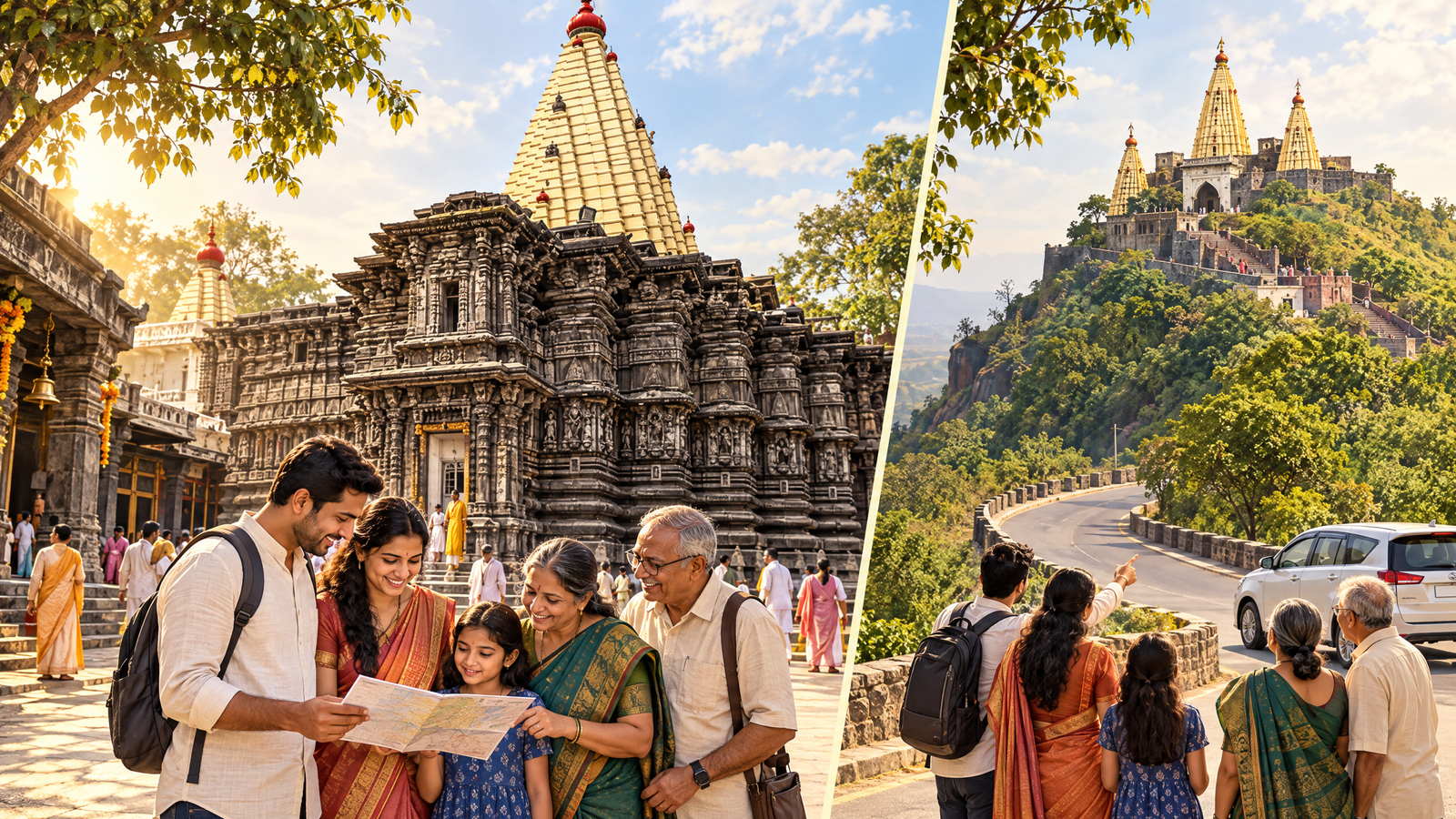
This guide is for a Mumbai-origin, chauffeur-driven journey. It is not a local Kolhapur car-service page. No route, overnight stop, shrine entry, vehicle or availability is confirmed by this planning outline. The official Ambabai temple website and the Ministry of Tourism’s Jyotiba listing identify distinct shrines.
Two shrines, two separate visits
Shree Karveer Niwasini Ambabai, also known as Mahalaxmi, is a temple in Kolhapur city. The temple describes its religious significance in the context of the Shakti Peetha tradition; this is a matter of religious belief. The Maharashtra Tourism overview provides historical and architectural context.
Jyotiba is a separate temple complex at Wadi Ratnagiri, outside the city, on a hilltop. The official Jyotiba Devasthan website and the Ministry of Tourism listing describe the site and its location. Regional religious traditions connect the two shrines, but that connection does not make them one visit or establish that every family follows the same ritual sequence.
Plan a distinct visit block for each shrine. Ambabai is an urban temple visit; Jyotiba involves a separate road journey to the hilltop complex. Queues, darshan, access arrangements and the time each group needs can vary. Do not treat published schedules or an assumed short queue as a guaranteed entry window.
Choose a trip shape before fixing the dates
Use this decision model to start planning—not to certify route safety:
| Your priority | Planning choice | What still needs confirmation |
|---|---|---|
| Visit both shrines at a less hurried pace | Keep separate visit blocks for Ambabai and Jyotiba, apart from the Mumbai road legs. Use the dated map examples below only to compare possible staging choices; neither a sequence nor a return split is validated as a complete daily itinerary. | Operations must verify actual daily road kilometres and driving hours, including assigned garage and pickup, Jyotiba access, all return legs and feasible overnight stages. The map examples do not establish a safe itinerary. |
| Consider fewer calendar days | Do not compress the shrine visits or infer that a direct road leg fits because a city-point map estimate appears manageable. | Ask Operations to check the complete, date-specific itinerary first. If any day cannot be verified within the planning ceiling, revise the stages or allow more time. |
| Travel on a festival date or for a particular aarti | Check both shrines separately before fixing the visit order and journey dates. | Current notices, darshan or aarti arrangements, crowd procedures, access and the full driving schedule. |
| Travel with children, older relatives or a passenger with access needs | Describe the group’s needs in the enquiry and keep the site visits flexible. | Current access, seating, assistance, vehicle drop-off and vehicle/luggage fit with the relevant shrine and operator. |
For editorial planning, use a conservative screen of 400 road kilometres or 12 driving hours on any calendar day; where the route supports it, roughly 325–350 km is a more cautious distance target. This is an editorial planning screen only—not a statement of Helios operating policy, a service term or a safety certification. It is separate from any applicable 300-km-per-committed-calendar-day billing minimum, which is a quote calculation rather than a route-planning limit. Operations must confirm actual daily movement and applicable quote terms. Count road driving separately from meals, breaks, check-in, darshan, queues and time at the hilltop site.
Dated route examples for comparing trip shapes
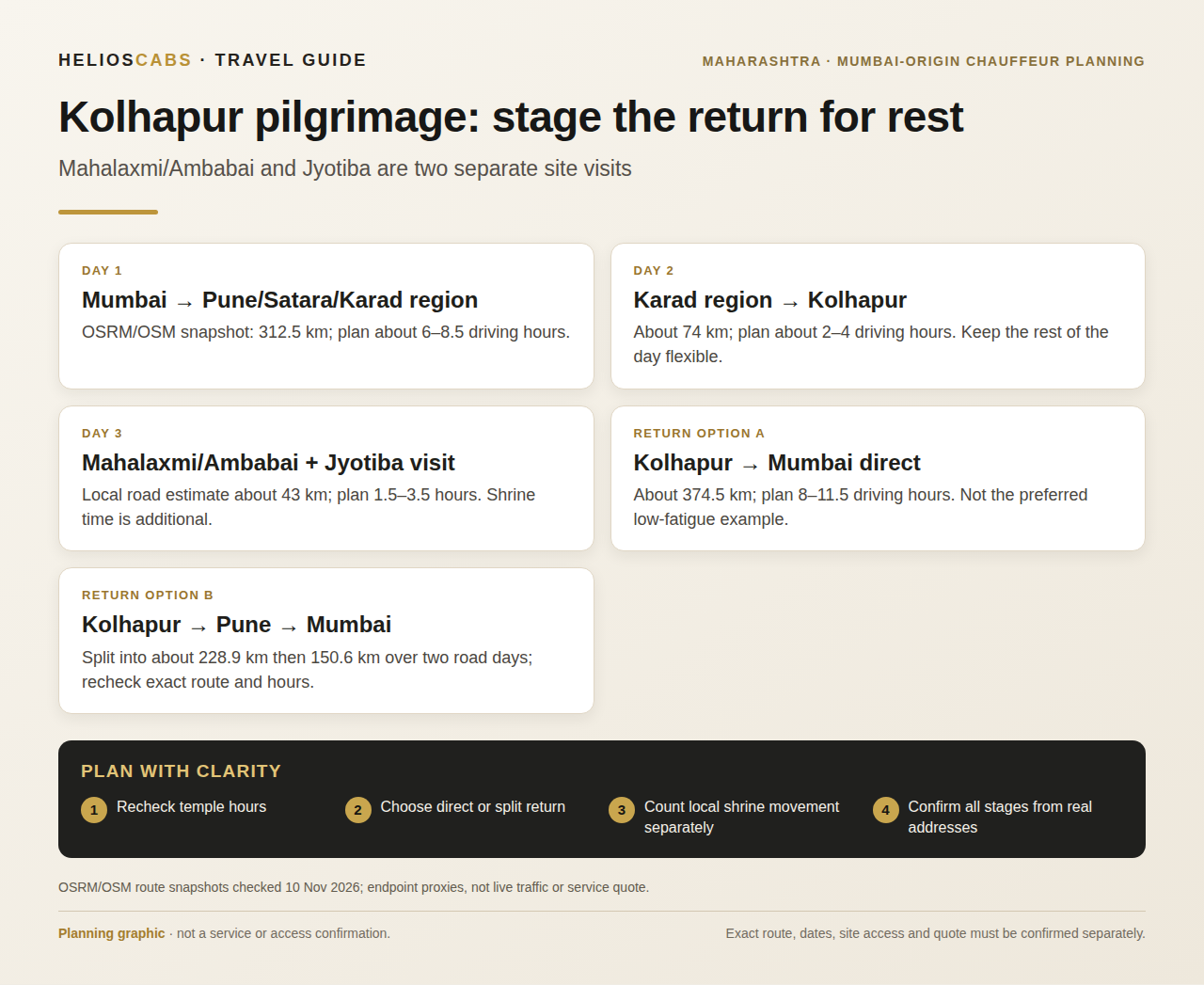
The following OSRM/OSM route-engine snapshots are dated 10 November 2026 and show approximate examples between representative city or regional points—not a complete shrine itinerary, verified daily stages or dispatch route. Driving-hour ranges are conservative planning allowances, not router promises. Darshan, queues, hilltop/site time and driver waiting are not included in map driving time; confirm any waiting terms separately. The 43-km local round-trip example is the Kolhapur–Jyotiba road portion only; site and temple time is extra. Keep Ambabai as a separate visit block rather than assuming it fits around a transfer or Jyotiba visit.
| Example corridor (dated map snapshot) | Route snapshot | Approx. road distance | Planning driving allowance |
|---|---|---|---|
| Mumbai–Pune–Satara–Karad | Multi-point outbound example | 312.5 km | 6–8.5 hours |
| Karad–Kolhapur | Regional road example | 74 km | 2–4 hours |
| Kolhapur–Jyotiba and return | Local round-trip example | 43 km round trip | 1.5–3.5 hours; site time extra |
| Kolhapur–Mumbai direct | Direct return example | 374.5 km | 8–11.5 hours |
| Kolhapur–Pune | Possible return-split segment | 228.9 km | Not supplied by this route audit; Operations must check |
| Pune–Saki Naka | Possible return-split segment | 150.6 km | Not supplied by this route audit; Operations must check |
The direct-return snapshot’s 8–11.5-hour allowance approaches the editorial screen before actual pickup/garage movement or date-specific conditions are checked; it is not a verified safe return plan. The Pune segment examples are options to have Operations evaluate, not a preferred or validated fatigue-reducing itinerary: the route audit supplies their approximate distances but no driving-hour ranges. No sequence of these snapshots establishes compliant daily driving or validates overnight stages. A complete calendar plan may need additional days for separate shrine visits.
The linked OSRM routing service documentation describes the route engine. These OSM/OSRM endpoint snapshots are not live-traffic forecasts, do not confirm road conditions or dispatch routing, and are not garage-to-garage distance estimates or a chauffeur quote. Exact pickup and drop addresses, assigned garage where applicable, date, route, stops, traffic, road conditions and temple arrangements must be checked before service confirmation. Operations must confirm kilometres and driving hours for every proposed calendar day, including the return, and review suitable overnight stages. Revise the trip shape or allow more days if the actual route or fatigue assessment calls for it; a map snapshot alone cannot establish safety.
Check each shrine’s current visitor arrangements
Before travel, check the Ambabai temple’s official pooja-schedule information and the Jyotiba Devasthan’s published schedule separately, along with current opening or closure notices, darshan and aarti arrangements, festival-day procedures, footwear and bag handling, photography or phone restrictions, vehicle access, parking, registration and identity-document requirements. Do not rely on an old screenshot or assume the same rules apply at both sites; contact the relevant shrine or Devasthan for date-specific guidance.
For Jyotiba, ask about current hilltop access and visitor arrangements before fixing the day’s plan. Keep the site visit and the road journey distinct in your schedule. The Ministry listing also advises that organiser-provided details may change; it is not a guarantee of entry or transport access.
If someone in your group has mobility, health or sensory needs, ask the shrine directly about current arrangements and tell the operator what the journey requires. This guide does not assume step-free access, seating, assistance or a particular vehicle drop-off. Carry essential medicines and water, keep passports and valuables with the family, and verify what identity documents each shrine accepts rather than assuming passport rules.
What the chauffeur journey may cover—and what to confirm
A Mumbai-origin chauffeur-driven trip can bring the road stages and separate shrine plan into one enquiry. Ask the operator to review the pickup address, route, proposed overnights, daily driving totals, Jyotiba access and separately checked return together. Sedans and Innova Crysta are established vehicle categories; suitability, passenger and luggage fit, driver, vehicle continuity and availability must all be confirmed for the specific enquiry.
A car booking does not arrange darshan or guarantee temple entry. Unless a written quote explicitly includes an item, do not assume that a temple pass, priest, guide, accommodation, meals, tolls, parking, waiting time, a particular driver or language, or local access is included. Confirm the inclusions, exclusions and any waiting or overnight terms in writing. Shrine authorities—not the driver—control entry, rituals and visitor rules.
For general service context, see Mumbai outstation car rental and outstation journey planning. For broader route choices, this Kolhapur plan sits within the Maharashtra pilgrimage circuits from Mumbai guide. The live Ashtavinayak Yatra guide covers a different pilgrimage and is not a substitute for checking this route.
Prepare a useful route enquiry
Share the details below so the team can assess the complete journey rather than assume an origin, stop or vehicle fit:
- Travel dates and the number of calendar days available.
- Mumbai pickup address and the preferred departure window.
- Passenger count, children’s ages, luggage and any mobility or health considerations.
- Whether you plan separate Ambabai and Jyotiba visit days, and any specific festival or aarti intention that still needs shrine confirmation.
- Preferred intermediate overnight regions, if any; these are requests, not confirmed stops.
- Preferred vehicle category, subject to availability and fit confirmation.
- Return date and Mumbai drop location.
- A request to verify actual route kilometres and driving hours for every calendar day in both directions, including pickup/garage movement and Jyotiba access.
- Written clarification of vehicle continuity, driver and overnight terms, tolls, parking, waiting, accommodation and other inclusions or exclusions.
Ask for a written quote and confirmation before making non-refundable accommodation or onward-travel arrangements. An enquiry is not a booking confirmation. Start through HeliosCabs contact and enquiry or review the Mumbai outstation service.
Frequently asked questions
Are Ambabai Mahalaxmi and Jyotiba the same shrine?
No. Ambabai, also known as Mahalaxmi, is the Kolhapur city temple. Jyotiba is a separate hilltop temple complex at Wadi Ratnagiri. Religious traditions connect the sites, but plan and verify them as two distinct visits.
Can I visit both shrines in one day?
Do not assume that you can. Each visit has its own travel, access and darshan considerations, and current arrangements and queues vary. For a Mumbai-origin journey, keep each shrine as a separate visit block unless your family and the relevant authorities confirm a suitable date-specific plan.
Does this route snapshot confirm a safe itinerary?
No. It is an illustrative OSRM/OSM snapshot, not a verified itinerary or safety assessment. It does not validate the assigned garage, exact pickup and drop addresses, date-specific route or traffic, local Jyotiba access, actual driving hours or fatigue. Operations must check every proposed stage and the actual service details before confirmation. The Pune segment examples are options for review only, not a confirmed or preferred service plan.
What are the shrine timings?
The official Ambabai and Jyotiba sites publish schedule information, but arrangements can change. Check directly with both shrines shortly before travel, especially for festival dates or a particular aarti. This guide does not promise an entry window or queue time.
Does a chauffeur booking include darshan, waiting or accommodation?
Only if the written quote specifically confirms the relevant service. Entry and darshan are controlled by the shrine authorities. Waiting, parking, guides, meals, accommodation, driver and vehicle arrangements also need explicit confirmation.
Plan around the pilgrimage, not an assumed map estimate
The practical starting point is to treat Ambabai and Jyotiba as two visits and the Mumbai road journey—including the return—as a route that still needs operational review. Choose the number of days your family can manage, check both shrines’ current arrangements directly, and do not turn a city-point routing snapshot into a promise of safe daily stages.
For a Mumbai-origin chauffeur enquiry, share your dates, pickup and return locations, passenger and luggage details, and separate shrine plan through HeliosCabs contact and enquiry. Route feasibility, route stages, vehicle, driver, access, timing, availability and quote require confirmation.
Sources
- Shree Karveer Niwasini Ambabai (Mahalaxmi) Temple — shrine identity, religious description and published schedule information.
- Maharashtra Tourism: Shree Mahalaxmi Ambabai Mata — historical and architectural overview.
- Shree Jyotirling Devasthan, Jyotiba — official Devasthan information and published schedule.
- Ministry of Tourism Utsav: Shri Jyotiba Temple — Wadi Ratnagiri location, site context and organiser-details disclaimer.
- OSRM routing service documentation — route-engine reference for the linked OSM/OSRM route snapshots dated 10 November 2026; the individual corridor links are shown in the route table and return-split paragraph above.
Plan your Mumbai-origin journey with the right checks
Share your dates, exact pickup and destination addresses, preferred stops, travellers and luggage, and how many calendar days you have. HeliosCabs can review the proposed chauffeur-driven road journey and confirm route, service coverage, vehicle suitability, availability and written terms before you rely on a plan. Site entry, darshan, boats, permits, accommodation and activities remain subject to their respective authorities or providers.
Share this article:

Leave a Reply