
📑 Table of Contents
- Why these pilgrimage clusters are different
- Choose a cluster by purpose
- Ashtavinayak: a dedicated Ganesha yatra
- Jyotirlingas: select shrines or plan distinct regional blocks
- Pandharpur: a focused Vitthal pilgrimage
- Kolhapur: Mahalaxmi/Ambabai and Jyotiba
- Jejuri and Dehu–Alandi: separate Pune-region visits
- Route planning and overnight logic
- Temple rules, group needs and service boundaries
- Prepare your enquiry
- Frequently asked questions
- Should I combine every major Maharashtra pilgrimage site in one circuit?
- Can I plan Mumbai–Jejuri as a same-day return?
- Does the chauffeur booking include darshan or aarti?
- What may change during Wari or Ekadashi?
- Plan one meaningful journey at a time
- Sources and further reading
- Plan your Mumbai-origin journey with the right checks
A Maharashtra pilgrimage is easier to plan when you choose one devotional region at a time. Ashtavinayak, the Jyotirlinga shrines, Pandharpur, Kolhapur, Jejuri and Dehu–Alandi lie in different directions from Mumbai and have distinct site demands and official arrangements. They do not automatically make one compact statewide circuit. Joining them all because they appear on one map can turn darshan into a rushed transfer schedule.
This guide helps families, NRIs and international visitors compare clusters and decide what may fit their plans. Every journey discussed is a Mumbai-origin, chauffeur-driven outstation enquiry. The route shapes below are planning illustrations, not confirmed itineraries, packages, temple bookings or promises of vehicle or site access.
Why these pilgrimage clusters are different
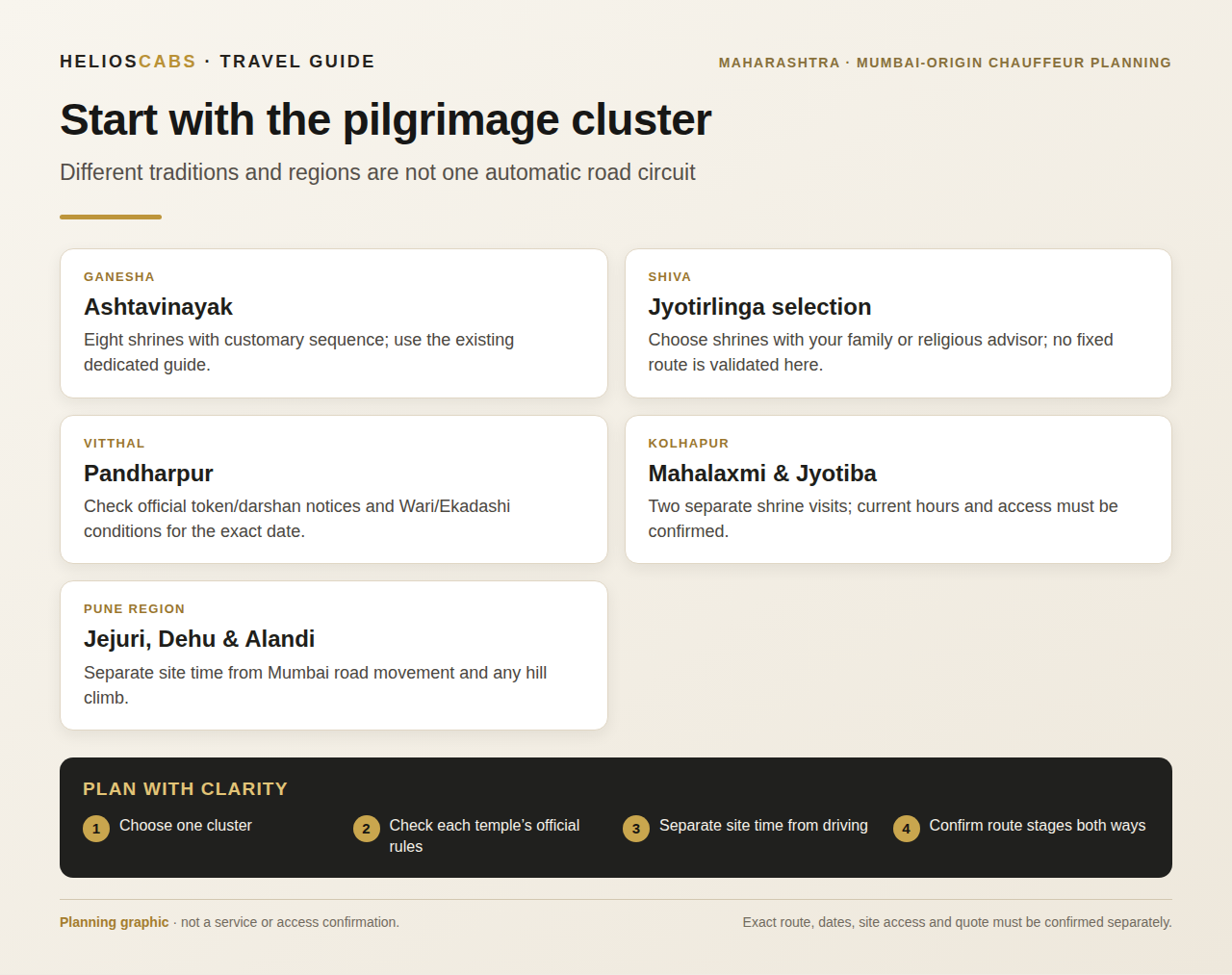
The commonly followed Ashtavinayak yatra links eight Ganesha shrines. Its customary sequence and paced Mumbai journey are covered in the dedicated Ashtavinayak guide. That guide has temple-by-temple detail, including Lenyadri’s steps; use this page to compare regions rather than repeat its itinerary.
Maharashtra Tourism’s Jyotirlinga leaflet presents a five-shrine grouping: Bhimashankar, Trimbakeshwar, Grishneshwar, Parli Vaijnath and Aundha Nagnath. The department also identifies Bhimashankar, Parli Vaijnath and Aundha Nagnath in that group. Traditions may count or group shrines differently, so confirm the form of yatra your family follows with a trusted religious source. These destinations span separate regions; consider a subset or separately staged travel rather than treating all five as a short loop.
Pandharpur is associated with Lord Vitthal and the Warkari tradition. Dehu and Alandi are linked with the devotional legacies of Sant Tukaram Maharaj and Sant Dnyaneshwar Maharaj; Maharashtra Tourism describes their shared pilgrimage context on its Dehu–Alandi page. Kolhapur offers another pairing: Ambabai (Mahalaxmi) in the city and hilltop Jyotiba nearby, both listed by Maharashtra Tourism’s Kolhapur district page. Jejuri, dedicated to Khandoba and set on a hill, is a distinct visit; consult Maharashtra Tourism’s Jejuri page when considering the climb or festival dates. These are different traditions and experiences, not interchangeable stops.
Choose a cluster by purpose
Ashtavinayak: a dedicated Ganesha yatra
If the complete Ganesha yatra is important to your group, keep Ashtavinayak as its own multi-day plan. Follow the customary sequence if that matters to your family, and use the existing Mumbai Ashtavinayak chauffeur itinerary for detailed planning. Avoid adding distant sites such as Kolhapur or Pandharpur simply to make the trip feel more comprehensive.
Jyotirlingas: select shrines or plan distinct regional blocks
Choose the shrines that matter most to your group. Western and central sites and the eastern shrines are better treated as separate planning blocks than assumed to be one short circuit. The five-Jyotirlinga circuit guide addresses shrine selection; its route stages still require checking and are not a validated daily itinerary. The Bhimashankar journey guide focuses on that shrine and its separate site considerations. For the existing Nashik and Trimbakeshwar route, see the live Mumbai–Nashik–Trimbakeshwar guide. A temple visit or sanctuary activity is site time, not driving capacity.
Pandharpur: a focused Vitthal pilgrimage
Treat Pandharpur as its own journey, especially around Ekadashi, Wari or Kartiki Yatra periods. Maharashtra Tourism’s Pandharpur page provides the Vitthal–Rukmini Mandir and Wari context. For service and booking rules, use the temple committee’s official pilgrim-services portal, not an unverified third-party claim. At the research-date snapshot (10 November 2026), the portal stated that token-darshan passes were unavailable on yatra days, festivals or Ekadashi, and that online booking services were suspended from 10 to 25 November 2026 for Kartiki Yatra. These are date-specific notices, not evergreen rules or confirmation of current arrangements: check the portal again for your own dates and do not rely on an old screenshot.
The Mumbai–Pandharpur Vitthal–Rukmini guide covers the chauffeur journey separately from temple arrangements.
Kolhapur: Mahalaxmi/Ambabai and Jyotiba
Keep Mahalaxmi/Ambabai and Jyotiba as a Kolhapur-focused cluster. Allow distinct time for each shrine and for the hill approach to Jyotiba. The Kolhapur Mahalaxmi and Jyotiba guide focuses on those visits. The official Ambabai temple site publishes pooja information; check the responsible authority for current arrangements on your dates.
Jejuri and Dehu–Alandi: separate Pune-region visits
Jejuri, Dehu and Alandi suit a separate pilgrimage plan rather than an assumed extension to a distant regional loop. Account separately for Mumbai road travel, the Jejuri hill climb and time at each town’s temple areas. A Google Maps snapshot dated 10 November 2026 showed Mumbai–Jejuri at about 194–197 km one way. That is a dated, generic outbound reference only: it does not establish the return route, garage-to-garage movement, total driving day or suitability for a same-day plan. Recheck each direction and allow for site time. For Dehu and Alandi, confirm the actual route and site arrangements for your dates.
The existing Mumbai–Shirdi guide is another distinct pilgrimage option; it is not a reason to combine Shirdi with every cluster.
Route planning and overnight logic
Use the following as selection frameworks only. No route order, overnight town or day count here is a validated customer itinerary. As an editorial planning screen—not a statement of Helios policy or a service promise—keep a proposed calendar day to no more than 400 road kilometres and 12 driving hours, preferring about 325–350 km where the available route evidence supports it. This screen is distinct from the separate 300-km minimum billing commitment per committed calendar day; billing does not validate a route or make a map estimate a driving promise. Count movement conservatively, including pickup and garage positioning where relevant. Breaks, local driving, darshan, queues, climbs and nature activities require separate time.
- Ashtavinayak: Start from the dedicated multi-day outline and consider a buffer for slower darshan, mobility needs or busy dates. Confirm all daily legs for the actual pickup and travel dates.
- Pandharpur: A Google Maps snapshot on 10 November 2026 showed about 356 km and 6 hours 19 minutes from generic Mumbai to Pandharpur endpoints via NH 965. This is a one-way snapshot, not a current route guarantee or evidence for the return. Treat outbound road movement, pilgrimage/site time and return movement as separate planning components; map both directions independently and add staged travel if the actual day would exceed either planning ceiling.
- Kolhapur: A Google Maps snapshot dated 10 November 2026 showed about 374 km and 6 hours 38 minutes. It is a dated one-way map leg, above the preferred distance range before breaks, garage movement or local shrine driving. Check the return separately; do not assume a Mumbai return after darshan or treat this snapshot as dispatch routing.
- Jejuri or Dehu–Alandi: Use the dated Jejuri outbound reference above only as orientation. Recheck the return and local movement independently; do not combine a hill climb or multiple site visits with Mumbai road travel on the assumption that the day fits.
- Five Jyotirlingas: Treat this as a multi-region undertaking, not an extension to a short trip. A generic Mumbai–Chhatrapati Sambhajinagar snapshot on 10 November 2026 showed about 344 km and 5 hours 31 minutes. It is an orientation point only, not a verified leg to Grishneshwar or any other shrine. Build and check every shrine-to-shrine, outbound and return leg before deciding duration. The live Mumbai–Nashik–Trimbakeshwar guide covers that distinct route; include Shirdi only if it genuinely belongs in your plan.
If the selected route, breaks and local movement put any day over either ceiling, split the movement across an overnight. Choose overnight locations only after the actual legs have been checked; no accommodation or overnight stop is selected or reserved by this guide. Never infer a return route from an outbound snapshot.
Temple rules, group needs and service boundaries
Check opening notices, darshan or aarti arrangements, festival information, dress, footwear, phone and bag rules with the shrine or its official booking site. Rules differ between temples and can change for processions or yatra days. For Pandharpur, follow the committee portal’s notices for the specific date. Do not book through an agent unless the shrine authority confirms that channel.
For family groups, discuss walking, stairs, heat, standing and waiting before selecting sites. Jejuri is hilltop and Lenyadri involves steps; queues and festivals add site time. Share passenger ages, mobility considerations and luggage with the transport team and ask it to confirm vehicle fit and operational arrangements. A vehicle category does not guarantee luggage fit or accessibility. NRIs and overseas visitors should confirm accepted identification and booking documents with the temple authority; do not assume a driver language or temple assistance.
A chauffeur-driven car can help a Mumbai group travel together between planned outstation stops. It does not itself provide darshan, temple tickets, a guide, reserved parking, priority entry, waiting, accommodation or confirmed vehicle continuity. Sedan and Innova Crysta requests, route, dates, service coverage, vehicle suitability and availability all require written confirmation. Check the Mumbai-origin outstation service and outstation planning page before requesting a quote. No fare or inclusion should be assumed from this guide.
Prepare your enquiry
Share the details below so the transport team can assess the requested journey. An enquiry is not a booking confirmation.
Trip purpose and shrine cluster:
Travel dates and requested number of calendar days:
Mumbai pickup address and preferred departure window:
Requested shrine order and any fixed darshan, puja or aarti plan:
Any festival, Ekadashi or Wari date involved:
Passenger count, ages of children and mobility considerations:
Luggage count and approximate sizes:
Preferred Sedan or Innova Crysta, subject to fit and availability confirmation:
Preferred overnight regions, if already decided:
Return date, final destination and any onward travel:
Please confirm route kilometres and driving hours by calendar day,
including garage movement, breaks and any required staged overnight:
Please list what is and is not included, including temple arrangements,
waiting, parking, tolls, overnight duty, driver allowance and taxes:
Contact name, phone/WhatsApp and preferred follow-up channel:
Frequently asked questions
Should I combine every major Maharashtra pilgrimage site in one circuit?
Not by default. The sites lie in different regions and have different road, darshan and site-time demands. Choose one devotional cluster first. Add another only after current route checks show that each calendar day can stay within the planning ceilings and each visit has enough time.
Can I plan Mumbai–Jejuri as a same-day return?
Do not assume so. The dated one-way map snapshot is not a return-route check. Verify both directions, garage movement, local driving and time for the hilltop visit before deciding whether an overnight is appropriate.
Does the chauffeur booking include darshan or aarti?
No temple service should be assumed to be included. Darshan, aarti, tickets and other temple arrangements are controlled by the shrine or its official booking operator. Arrange them separately and ask HeliosCabs to state transport inclusions in writing.
What may change during Wari or Ekadashi?
Crowds, traffic, local restrictions and booking arrangements may change. The portal’s 10 November 2026 research-date snapshot stated that token darshan passes were unavailable on yatra days, festivals or Ekadashi; this does not establish arrangements for another date. Recheck official information close to travel; no route plan guarantees entry or queue length.
Plan one meaningful journey at a time
Choose the shrine cluster that matters most, check official arrangements and give road travel enough calendar days. Then send HeliosCabs the enquiry details through the Mumbai outstation page or contact page. Ask for the route, vehicle, overnight assumptions and inclusions in writing before making non-refundable temple, hotel or onward-travel commitments. An enquiry is not a booking confirmation.
Related live pilgrimage guides: Ashtavinayak Yatra, Mumbai to Shirdi, and Mumbai–Nashik–Trimbakeshwar.
Sources and further reading
- Jyotirlinga leaflet
- Bhimashankar
- Parli Vaijnath
- Aundha Nagnath
- Dehu–Alandi page
- Maharashtra Tourism’s Kolhapur district page
- Maharashtra Tourism’s Jejuri page
- Pandharpur page
Plan your Mumbai-origin journey with the right checks
Share your dates, exact pickup and destination addresses, preferred stops, travellers and luggage, and how many calendar days you have. HeliosCabs can review the proposed chauffeur-driven road journey and confirm route, service coverage, vehicle suitability, availability and written terms before you rely on a plan. Site entry, darshan, boats, permits, accommodation and activities remain subject to their respective authorities or providers.
Share this article:

Leave a Reply