
📑 Table of Contents
- Start with the temple’s current instructions
- Choose the route shape before requesting a quote
- 1. Trimbakeshwar-focused return
- 2. Nashik, Panchvati and Trimbakeshwar
- 3. Two-day pilgrimage and sightseeing plan
- Plan around people, bags and walking
- Understand the Helios quote basis
- Copyable enquiry checklist
- FAQs
- Is Trimbakeshwar suitable as a Mumbai one-day return?
- Can I include Panchvati and Ramkund with Trimbakeshwar?
- Does Helios arrange the Trimbakeshwar darshan pass or puja?
- What should international visitors carry?
- Can Helios guarantee temple parking or a drop at the entrance?
- Planning a Mumbai–Nashik–Trimbakeshwar route?
- Sources and further reading
A Mumbai-to-Trimbakeshwar journey is easy to describe as a destination transfer. For a family, NRI group or overseas visitor, it is usually a more important planning decision: do you want only the Jyotirlinga darshan, a Nashik–Panchvati circuit as well, or a slower overnight pilgrimage with sightseeing?
That choice affects the departure plan, time available for the temple queue, walking tolerance, bags, passenger ages, weather buffer and whether returning to Mumbai the same day is sensible. A chauffeur enquiry can structure the road journey, but it cannot replace the Trust’s darshan instructions or guarantee a vehicle, route, waiting arrangement or temple access.
Start with the temple’s current instructions
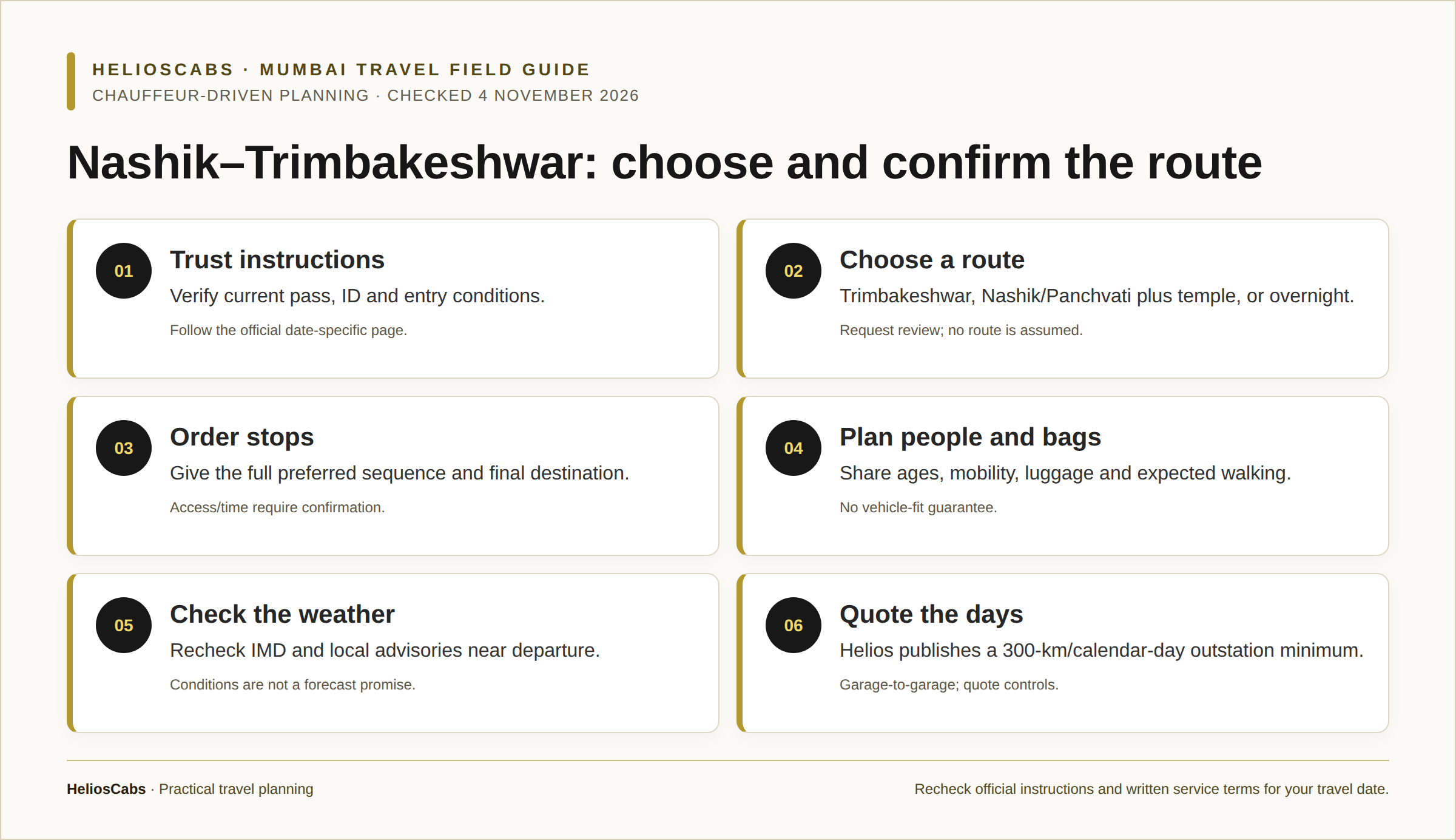
The official Trimbakeshwar Devasthan Trust identifies Trimbakeshwar as one of the twelve Jyotirlingas and provides online services including donation darshan passes, puja bookings and accommodation enquiries. Its current online donation-darshan page says the pass is valid for the same date, with last entry valid until 9:00 pm. It also says devotees must carry identity proof and the QR pass for entry verification, and that the pass is non-transferable. The page currently lists the donation darshan pass at ₹200 per person; it says children below 10 and Divyangjan are exempt from the charge, with valid disability proof required for Divyangjan.
Treat those instructions as date-sensitive. Before travelling, check the selected date and pass conditions and keep the QR code and identification accessible. Do not ask a car operator to promise priority entry, a shorter queue or special access. A transport booking and a temple pass are separate arrangements.
Maharashtra Tourism places Trimbakeshwar about 28 kilometres from Nashik city and describes it as a Jyotirlinga temple near the Brahmagiri hills. The same official tourism source presents Nashik as a wider destination: Panchvati and Ramkund for religious and riverside heritage, Pandavleni for hill caves, and wineries such as Sula for a different kind of visit. That is why a one-way Trimbakeshwar drop may be too narrow for the trip you actually want.
Choose the route shape before requesting a quote
1. Trimbakeshwar-focused return
Choose this when darshan is the non-negotiable purpose and the group wants to return to Mumbai rather than stay in Nashik. Send the requested departure and return windows, but do not assume that a same-day return will be accepted or comfortable. The temple queue, road conditions, breaks and the time needed by older passengers can change the day substantially.
If you are travelling with children or elders, ask for a realistic schedule rather than simply the earliest possible start. Confirm whether the proposed service is a round-trip outstation booking, how the committed calendar day is treated, and whether waiting, tolls, parking or other route costs are included or charged separately.
2. Nashik, Panchvati and Trimbakeshwar
This is often the more complete pilgrimage shape. You might spend time in Panchvati and at Ramkund, continue to Trimbakeshwar for the temple visit, then stay in Nashik or return if the confirmed schedule permits. The official Nashik page also lists Pandavleni Caves and vineyards, but these are not interchangeable quick stops: Pandavleni involves a hill approach, while a winery visit has its own opening and booking conditions.
Write the preferred order rather than saying “cover Nashik.” For example: Mumbai pickup → Nashik hotel or Panchvati → Ramkund → Trimbakeshwar → Nashik overnight. Ask Operations to check the route, date, vehicle and stop sequence. Do not assume that the chauffeur will remain continuously assigned, wait through every stop or provide local guide service.
3. Two-day pilgrimage and sightseeing plan
An overnight plan is usually easier to pace when the group has checked luggage, a puja appointment, mobility concerns, a late arrival, or several Nashik stops. One possible structure is Mumbai to Nashik on day one, with Panchvati or Ramkund if time and access suit the group; Trimbakeshwar darshan and a return to Nashik on day two; then Mumbai or another approved destination.
This is an itinerary example, not a promised route. Ask whether Helios can accept the destination combination, whether one vehicle is retained or the legs are quoted separately, and how overnight duty, accommodation, driver allowance, tolls, parking and extra use would be handled. If a request becomes a long-stay or monthly arrangement, ask Operations to review it separately; do not assume that an outstation quote converts into a monthly product.
Plan around people, bags and walking
Share the number of adults, children and older passengers, along with approximate luggage count and any mobility or child-seat request. Helios’s approved rate card supports Sedan and Innova Crysta categories, but vehicle availability and luggage fit still require confirmation. A seating category is not a promise about suitcase, mobility-aid or equipment fit.
Keep temple essentials in a small day bag and avoid carrying unnecessary luggage into the pilgrimage portion of the day. The Trust’s online instructions require identity proof and a QR pass for donation-darshan entry. Ask the Trust directly about any current restrictions on bags, phones, photography, dress or offerings; do not rely on a chauffeur to interpret temple rules.
Maharashtra Tourism describes summer as hot, monsoon as rainy, and October to March as more comfortable for outdoor exploration. Rain can affect road pace and hill or cave visits, while summer heat can be difficult for a group walking between stops. Check the India Meteorological Department and relevant highway advisories close to departure. Weather information is a planning input, not a journey-time guarantee.
Understand the Helios quote basis
Helios’s published terms state that services are subject to availability and confirmation and that outstation billing has a minimum of 300 kilometres per committed calendar day on a garage-to-garage basis. The terms also describe tolls, parking and state taxes as actuals. These are Helios-specific published terms, not a universal market standard. Ask Operations to itemize any applicable driver allowance, tax, tolls, parking, night conditions and other components in the written quote; do not infer a final amount from this guide.
For a multi-stop Nashik plan, ask for the verified garage-to-garage kilometres and committed calendar days in writing. A map distance between Mumbai and Trimbakeshwar is not the same as the billable garage-to-garage route. Also ask how extra kilometres, late return, night conditions, waiting, route changes and overnight duty would be treated. Helios’s terms say confirmation requires its booking, vehicle and chauffeur message.
For context, see the Mumbai outstation car rental pillar, the Helios booking and service terms, and the Mumbai local car rental page if you plan a separate Mumbai sightseeing day before or after the pilgrimage. After an international arrival, use the Mumbai airport transfer page as a separate planning reference; airport pickup treatment must be confirmed and should not be assumed to include an outstation continuation.
Copyable enquiry checklist
Send this information in one message:
- Mumbai pickup address, or airport and terminal if relevant;
- travel date, preferred departure window and required return or overnight plan;
- Trimbakeshwar darshan date, Trust pass status and any puja appointment;
- Nashik stops, such as Panchvati, Ramkund, Pandavleni or a winery, in preferred order;
- passenger count, children’s ages, older passengers and mobility considerations;
- luggage count, approximate sizes and any equipment;
- preferred Sedan or Innova Crysta category;
- whether you want one-way, same-day return, Nashik overnight or a multi-day itinerary;
- requested final drop, contact number and WhatsApp availability; and
- questions about route approval, vehicle, garage-to-garage kilometres, calendar-day billing, driver allowance, tolls, parking, waiting, extra use, GST and cancellation terms.
Ask Helios to confirm the route and fulfilment model before treating the plan as accepted. Send a Mumbai chauffeur-driven travel enquiry with these details.
FAQs
Is Trimbakeshwar suitable as a Mumbai one-day return?
It may be possible for some groups, but the return should be treated as a date-specific Operations review. Darshan queues, traffic, breaks, weather and passenger pace can materially change the day. Request a return plan rather than assuming one.
Can I include Panchvati and Ramkund with Trimbakeshwar?
You can request that combination, but the stop order, vehicle, route acceptance and available time must be confirmed. Nashik and Trimbakeshwar are distinct parts of the itinerary, not one temple entrance.
Does Helios arrange the Trimbakeshwar darshan pass or puja?
Do not assume so. The Trust operates its own online donation-darshan and puja services. Arrange and verify temple services through the official Trust portal, then ask Helios only about the transport requirement.
What should international visitors carry?
Keep the identity proof and Trust QR pass required by the official donation-darshan instructions available. Carry contact and accommodation details, plus any travel documents appropriate to your trip. Temple entry and luggage rules should be checked with the Trust for your date.
Can Helios guarantee temple parking or a drop at the entrance?
No such guarantee should be inferred from a route enquiry. Ask Operations to explain the lawful vehicle access, drop-off, waiting and parking treatment for the confirmed date and location.
A good Mumbai–Nashik–Trimbakeshwar plan starts with the darshan rules, then fits the route around people and time. Share the complete itinerary with Helios, request a written quote and wait for explicit confirmation of the route, vehicle and commercial terms before making non-refundable travel commitments.
Planning a Mumbai–Nashik–Trimbakeshwar route?
Share the Trust pass date, preferred stop order, travel dates, passengers, luggage and return or overnight plan. Ask Operations for written route, vehicle and outstation terms.
An enquiry is not a booking confirmation. Route, vehicle, availability and applicable written terms require confirmation.
Sources and further reading
- Shri Trimbakeshwar Devasthan Trust
- Official Donation Darshan Pass Instructions
- Trimbakeshwar Trust Online Services
- Maharashtra Tourism: Nashik
- Maharashtra Tourism: Trimbakeshwar
- India Meteorological Department: Mumbai Region
- Helios Cabs: Mumbai Outstation
- Helios Cabs Terms of Service
- Helios Cabs: Mumbai Local Car Rental
- Helios Cabs: Mumbai Airport Transfer
- Helios Cabs Mumbai Chauffeur-Driven Travel Enquiry
Share this article:

[…] page. For related Maharashtra pilgrimage planning, see HeliosCabs’ guides to Mumbai–Shirdi and Mumbai–Nashik–Trimbakeshwar. Route, vehicle, availability, waiting, access and quote remain subject to written […]
[…] same-wave pages are staged at their exact canonicals. Existing contextual reading includes the Mumbai–Nashik and Trimbakeshwar chauffeur guide and the Ashtavinayak Yatra guide. To discuss a Mumbai-origin multi-day journey, use Mumbai […]
[…] and its separate site considerations. For the existing Nashik and Trimbakeshwar route, see the live Mumbai–Nashik–Trimbakeshwar guide. A temple visit or sanctuary activity is site time, not driving […]