
📑 Table of Contents
Corporate mobility decisions touch procurement, travel coordination, facilities, HR, finance and the employees who use the service. HeliosCabs’ corporate mobility simulator gives learners a scenario-based way to think through operational, crisis and strategy questions. Its Level 1 is marked free for all users; later stages are score-gated, so the entire three-level path should not be described as immediately unlocked or free.

What the three stages cover
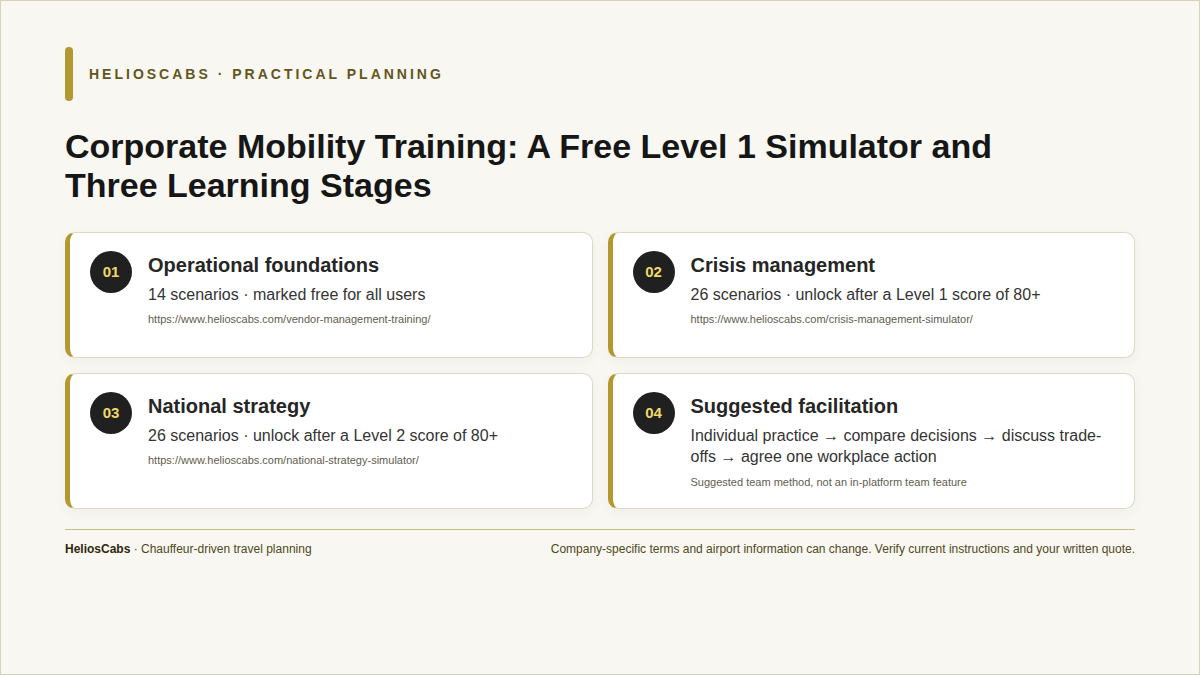
The current simulator page describes 66 scenarios across three progressive levels. Level 1, Operational Foundations, has 14 scenarios about vendor selection, contract negotiation and day-to-day management. It is marked free to start. Learners who score 80 or higher can unlock Level 2, Crisis Management, with 26 scenarios around vendor failures, safety incidents and multi-vendor coordination. A score of 80 or higher in Level 2 unlocks Level 3, National Strategy, which contains 26 advanced scenarios about broader mobility planning and policy.
Check the simulator overview for the current level descriptions and access conditions. Individual levels are available at Level 1: vendor-management training, Level 2: crisis management and Level 3: national strategy.
How a company can use Level 1 with a team
The simulator is presented as an individual interactive experience. A company can still use it as the basis of a facilitated team exercise without assuming that the platform has a built-in group dashboard or shared cohort controls. One practical approach is to ask participants to complete Level 1 individually, note the scenario where they felt least certain, and bring their reasoning to a short cross-functional discussion.
Invite procurement, travel operations, HR, facilities and finance to compare how they would assess a vendor, respond to a service problem or balance cost with employee experience. Ask each person to explain the information they relied on, the risk they considered and what would change their decision. The facilitator can then capture one policy or escalation question for the company to review. Keep the discussion focused on decision quality rather than treating a simulation score as a complete measure of job performance.
Why the debrief matters
Research on online business simulations has examined their use as an environment for team-based learning in business courses. One multi-institution study, drawing on 365 student surveys and focus groups with 14 students across institutions in Australia and Hong Kong, reported relationships between teamwork, management-related learning outcomes and learner satisfaction. That study concerns higher-education business simulations, not this specific HeliosCabs simulator, and it does not prove that any one exercise will improve workplace performance.
A separate study of business-simulation teaching methods found that students’ perceived transfer of learning varied with how they prepared and worked through decisions. For a corporate session, this supports a modest practical choice: give learners time to understand the scenario instructions, compare their reasoning with peers and discuss how a decision might translate—or fail to translate—to the company’s real procurement rules. It is a discussion prompt, not a guarantee of learning transfer.
A simple three-stage team pathway
- Start with Level 1. Use the free operational-foundations scenarios as individual pre-work, then discuss decision differences as a group.
- Use Level 2 for crisis conversations. Once a participant meets the stated score threshold, use the crisis scenarios to prompt a separate discussion about escalation, continuity and responsibility. Do not represent the level as unlocked before the platform confirms it.
- Use Level 3 for strategic reflection. Eligible learners can explore the national-strategy scenarios and discuss policy, governance and coordination questions relevant to their organisation.
For a useful internal exercise, end each session with one action the team can test in its own travel or vendor process. Keep company policy, legal obligations and contract terms authoritative; the simulator is a learning aid, not a replacement for them.
Begin with the free stage
Visit the HeliosCabs corporate mobility simulator and start Level 1 vendor-management training. Review current access and progression terms on the page before assigning it to a group. If your organisation is separately seeking chauffeur-driven corporate transport, use the existing corporate car-rental enquiry page or the approved corporate/MICE enquiry form; training participation does not create a transport booking or vendor relationship.
Sources and further reading
- Online business simulations: authentic teamwork, learning outcomes, and satisfaction — Higher-education study; contextual evidence, not validation of the HeliosCabs simulator.
- Improving transfer of learning: relationship to methods of using business simulation — Business simulation teaching-method study; do not generalize its student findings to guaranteed workplace outcomes.
Share this article:

Leave a Reply