
📑 Table of Contents
- Start with the shrines and your group, not a fixed route
- Use regional clusters as a selection aid
- Validate every road day before choosing overnight towns
- Check shrine guidance and allow time for visits
- What a chauffeur enquiry covers—and what needs confirmation
- Frequently asked questions
- Is there a validated 12-day route for all five shrines?
- Which shrine order should we follow?
- Can we combine Grishneshwar and Ellora in one visit?
- Are darshan, accommodation and waiting included in a chauffeur booking?
- What should older travellers, children or visitors with access needs consider?
- Plan around verified stages, not a promised duration
- Sources and further reading
- Plan your Mumbai-origin journey with the right checks
Start with the shrines and your group, not a fixed route
Maharashtra’s five Jyotirlinga shrines are Bhimashankar, Trimbakeshwar, Grishneshwar, Aundha Nagnath and Parli Vaijnath. They are revered by devotees as five of India’s twelve Jyotirlingas. A visit can be a meaningful family pilgrimage, but the shrines lie across different parts of the state. This guide is for planning a Mumbai-origin, chauffeur-driven journey; it does not prescribe a religious sequence or provide a mapped, safety-validated multi-day itinerary.

The first decision is whether your group intends to visit all five shrines or focus on one regional cluster. Consider the time your group can set aside, any sequence advised by family or a trusted religious source, mobility and rest needs, and date-specific temple arrangements. A road-efficient order is not automatically a religiously appropriate one.
For a wider comparison of devotional journeys, see the Maharashtra pilgrimage-circuit overview. The Bhimashankar guide focuses on that shrine and its visit considerations.
Use regional clusters as a selection aid
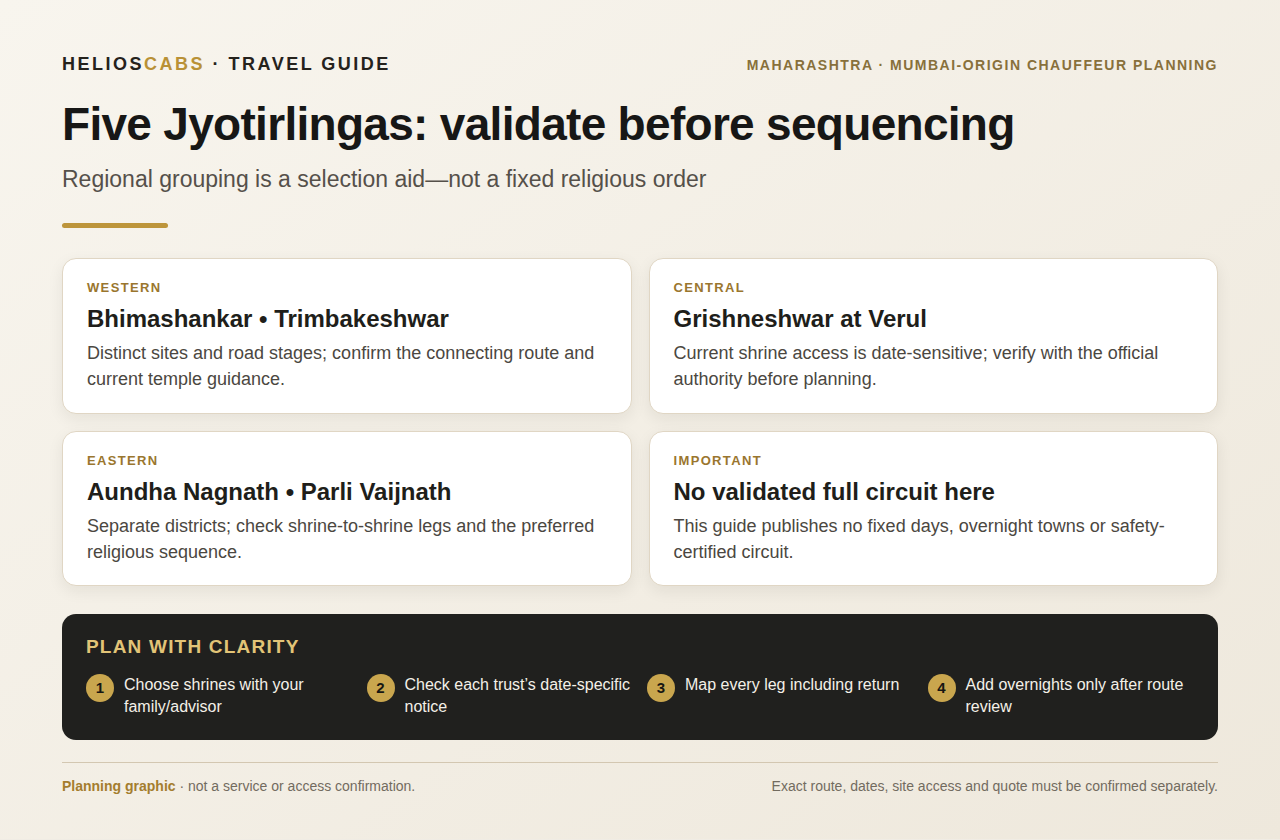
The grouping below is geographic orientation, not a route order, a promise that neighbouring shrines make a short drive, or a recommendation to complete each cluster in a set number of days. Local terrain, route choice, pickup point and travel date can change the practical plan.
| Broad cluster | Shrines | What to consider |
|---|---|---|
| Western | Bhimashankar and Trimbakeshwar | These are distinct shrine visits in different settings. Check the Sahyadri approach for Bhimashankar and the current Trust instructions at Trimbakeshwar. Do not assume the connecting road leg or an overnight location without mapping it. |
| Central | Grishneshwar at Verul, near Ellora in the Chhatrapati Sambhajinagar region | Decide whether the group wants only darshan or a separate heritage visit as well. Ellora needs its own visitor-rule and site-time check; proximity does not make it an automatic inclusion. |
| Eastern | Aundha Nagnath in Hingoli district and Parli Vaijnath in Beed district | Treat the two shrine visits and the connecting road stage as separate planning questions. Confirm the group’s preferred sequence and map each leg before choosing a stop. |
This framework helps narrow the enquiry without turning regional labels into unsupported drive estimates. A group choosing fewer shrines can discuss a cluster-specific plan; anyone considering all five should expect route order and staging to depend on current, end-to-end checks.
Validate every road day before choosing overnight towns
The research available for this guide did not yield publication-grade route directions for the complete circuit. A directions attempt returned no usable route details, and approximate geocoded routing was ambiguous and is not accepted as validation. For that reason, this article does not publish a day-by-day schedule, name overnight towns, or say that a planned number of stages meets road-safety limits.
Before a quote or itinerary is prepared, the route needs to be checked in a current mapping source for the actual pickup point and travel dates. Review every proposed driving day, including the first movement from the applicable starting point and the complete return to Mumbai. Do not assume the return follows the outbound route or takes a comparable amount of time. Select overnight towns only after those checks identify feasible daily endpoints and suitable lodging options.
Use the following decision sequence with the operations team:
- Set the religious and visitor priorities. Confirm which shrines the group wants to visit, any family or religious sequence, likely visit dates, and whether a separate Ellora visit is desired.
- Map the full journey, both directions. Check each leg using the real pickup and stop endpoints for the date, not just shrine-to-shrine map pins. Review the outbound and return independently, and include actual route movement required by the approved service arrangement.
- Test each calendar day. As an editorial planning screen—not a Helios safety policy or service guarantee—flag any proposed day above 400 road kilometres or 12 driving hours for re-planning. Where current evidence supports it, prefer around 325–350 road km per day. Meeting either screen does not validate a route or prove it is safe. This screen is separate from the 300-km-per-calendar-day minimum that may apply in outstation billing; that is a billing calculation, not a safe-driving allowance. Darshan, queues, meals, breaks and rest are additional to driving time.
- Add or move an overnight when needed. If any mapped day exceeds either ceiling, or leaves inadequate time for rest and the group’s needs, revise the stages and check again. Do not choose an overnight town by guesswork or infer safety from a single transfer per day.
- Recheck the visit separately. Ask each shrine or responsible authority about the rules and arrangements that apply on the intended date. A confirmed road plan does not secure darshan, entry, accommodation or a site activity.
Only after the route, driving hours and distance for every day—including the return—are verified should a proposed staging plan be described as suitable for that particular enquiry. Until then, regional clusters are a selection framework, not a confirmed itinerary.
Check shrine guidance and allow time for visits
Temple schedules, queues and arrangements may change, especially around festivals. Check current instructions with each responsible authority before travel. The Bhimashankar Trust schedule publishes its programme and visitor instructions; Maharashtra Tourism’s Bhimashankar page describes the shrine’s Sahyadri setting and the surrounding sanctuary. The Trimbakeshwar Devasthan Trust identifies the shrine as a Jyotirlinga pilgrimage centre at the Godavari’s source, and its daily programme notes that timings can change on festival days.
For the other shrines, consult Maharashtra Tourism’s pages for Grishneshwar, Aundha Nagnath and Parli Vaijnath. These sources support shrine identity and location context; they are not a substitute for checking current operating instructions directly with the relevant temple authority. For Grishneshwar, the research check dated 10 November 2026 did not establish a primary, date-specific opening or reopening notice. This dated evidence gap is not a statement that the shrine is currently open or closed; confirm access directly with the responsible authority before finalising travel.
Ask about darshan and puja arrangements, closures, footwear, dress, phones, photography, bags, offerings, identity documents and any booking process that applies to your visit. Rules differ by shrine. For NRIs and international visitors, confirm which documents and booking steps are accepted rather than relying on a general assumption.
Keep temple visits and any separate heritage or nature activity as site time, outside the driving-day allowance. Queues, walking, meals and rest also need their own buffers. Forest walks or treks near Bhimashankar are separate activities; confirm current access, weather and physical suitability with the responsible authority.
What a chauffeur enquiry covers—and what needs confirmation
A HeliosCabs enquiry is for a Mumbai-origin chauffeur-driven road journey. It is not a promise that a particular driver or vehicle is available, that a proposed route is approved, or that a temple or site will admit the group at a requested time.
Share the information below so the team can review the entire proposed journey rather than only its first leg:
Journey: Mumbai-origin chauffeur-driven five-Jyotirlinga enquiry
Travel dates and the total calendar days available:
Mumbai pickup address and preferred departure window:
Shrines requested and preferred religious/family sequence:
Planned shrine visit dates and any fixed puja or darshan arrangements:
Whether a separate Ellora visit is desired:
Passenger count, children’s ages and mobility considerations:
Luggage count and approximate size:
Preferred vehicle category, subject to availability and fit confirmation:
Existing accommodation bookings or preferred overnight requirements:
Requested Mumbai return date and onward travel constraints:
Please check the current route for each day and the return, including road km,
driving hours, endpoints, breaks and proposed overnight towns:
Please state confirmed service inclusions and exclusions, including driver,
vehicle, waiting, parking, tolls, permits, accommodation and site access:
Contact number and preferred follow-up channel:
Vehicle category, passenger and luggage fit, driver assignment, availability, language preference, permits, tolls, parking, waiting, accommodation, local access, guide, entry, darshan, accessibility and final quote all require explicit confirmation. Darshan, temple bookings, accommodation, guides, forest access and local activities are separate unless expressly confirmed in writing. An enquiry is not a booking confirmation.
To request a date-specific review, use the Mumbai outstation enquiry page or contact HeliosCabs. The outstation planning guidance can help your group prepare questions. Ask for the mapped daily route and overnight proposal to be confirmed before making non-refundable plans.
Frequently asked questions
Is there a validated 12-day route for all five shrines?
No validated 12-day route is established here. The available route evidence does not validate every daily leg or the return, so this guide does not offer a fixed day-by-day schedule. Current mapping from the actual pickup point and travel-date endpoints is needed before assigning overnight towns or assessing a proposed schedule against the editorial planning screen.
Which shrine order should we follow?
This guide does not prescribe a religious sequence. If order matters to your family or tradition, consult your trusted religious source first. Then have the road order and each stage checked independently; geographic grouping alone does not establish a suitable route.
Can we combine Grishneshwar and Ellora in one visit?
They are in the same broad area, but Ellora is a separate heritage visit with its own current visitor rules and site-time needs. Confirm those details with the responsible authority and have the full day’s road movement checked before adding it to the plan.
Are darshan, accommodation and waiting included in a chauffeur booking?
Do not assume they are. The written quote must state the confirmed vehicle and driver arrangements and any waiting, parking, toll, permit or other service terms. Temple access, darshan, accommodation, guides and activities remain separate unless explicitly confirmed.
What should older travellers, children or visitors with access needs consider?
Tell the enquiry team about ages, mobility, luggage and preferred rest pace. Confirm physical access directly with each shrine, allow time for queues and walking, and avoid relying on best-case driving assumptions. Vehicle suitability and assistance must be confirmed rather than presumed.
Plan around verified stages, not a promised duration
The five shrines form a multi-region pilgrimage, but the available evidence does not establish a validated route or overnight sequence. Choose the shrines and visit priorities first, then request current mapping of every driving day and the return before settling on stops or a total schedule. HeliosCabs can review a Mumbai-origin chauffeur enquiry; route suitability, driver, vehicle, availability, site access and quote remain subject to confirmation.
Sources and further reading
- Bhimashankar Trust schedule
- Bhimashankar page
- Trimbakeshwar Devasthan Trust
- daily programme
- Grishneshwar
- Aundha Nagnath
- Parli Vaijnath
Plan your Mumbai-origin journey with the right checks
Share your dates, exact pickup and destination addresses, preferred stops, travellers and luggage, and how many calendar days you have. HeliosCabs can review the proposed chauffeur-driven road journey and confirm route, service coverage, vehicle suitability, availability and written terms before you rely on a plan. Site entry, darshan, boats, permits, accommodation and activities remain subject to their respective authorities or providers.
Share this article:

Leave a Reply