
📑 Table of Contents
- Ashtavinayak Yatra from Mumbai: begin with the route, then set the pace
- The eight temples and why each stop matters
- A paced six-day Mumbai-origin outline
- What to decide before choosing the order
- How a chauffeur-driven car can help—and what it does not include by default
- Practical checklist for Indian, NRI and international visitors
- Copy this enquiry brief when requesting a quote
- Common questions
- What is the traditional Ashtavinayak order?
- How many days should I allow from Mumbai?
- Can the full yatra be completed in three days?
- Does a chauffeur booking include temple tickets or special darshan?
- Can the driver wait while the family visits each shrine?
- Is Lenyadri suitable for every traveller?
- Plan the pilgrimage around the people, not only the map
- Planning an Ashtavinayak Yatra from Mumbai?
- Sources and further reading
Ashtavinayak Yatra from Mumbai: begin with the route, then set the pace
The Ashtavinayak Yatra links eight revered Ganesha temples in Maharashtra. The commonly followed devotional sequence begins at Morgaon, continues through Siddhatek, Pali, Mahad, Theur, Lenyadri, Ozar and Ranjangaon, then returns to Morgaon. Maharashtra Tourism identifies Morgaon as the first and final stop; the full sequence is also described in regional route references. Follow the order if it matters to your family’s practice, and confirm any specific tradition with a trusted religious source. Maharashtra Tourism: Morgaon Route sequence reference
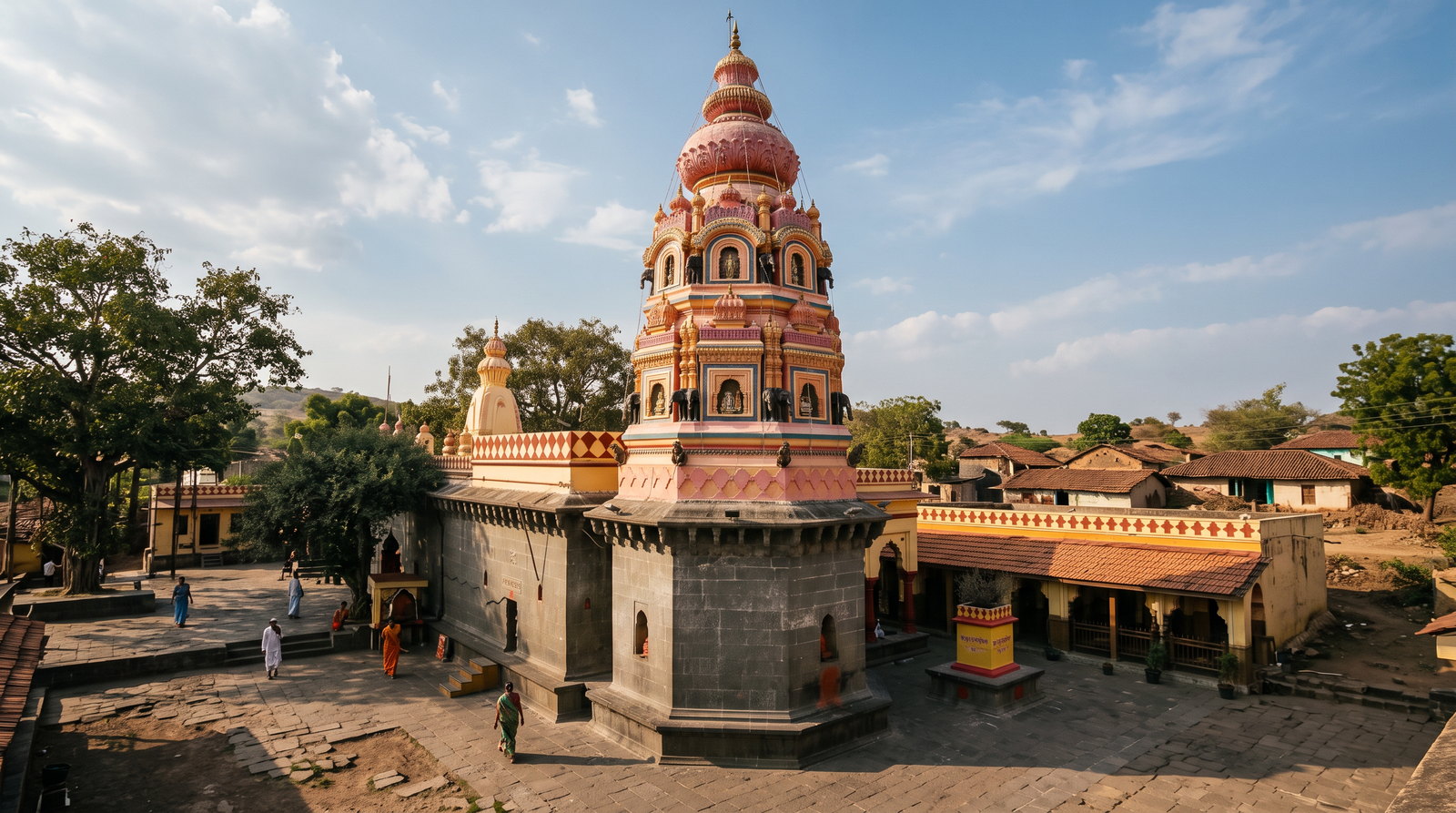
For a Mumbai-origin journey, the practical question is not only “Can all eight temples fit?” It is “How many days leave enough room for the road, darshan, meals, rest, queues and the climb at Lenyadri?” A chauffeur-driven car can make a multi-stop plan easier to discuss and coordinate, but it does not provide temple bookings, priority darshan, a guide, guaranteed parking or a confirmed vehicle until HeliosCabs Operations accepts the written itinerary.
A useful starting point is a six-day planning outline with a seven-day fallback if a long leg, temple queue, weather or passenger comfort makes one day too full. Treat it as a trip-design example—not a fixed Helios package, quoted distance or promise of availability. Check each shrine’s current opening, closure and visitor instructions for your dates.
In brief: confirm whether you want the customary order; allow multiple calendar days; group nearby temples only after checking the actual route; treat Lenyadri’s steps as a real physical-effort decision; and request a written Mumbai-origin outstation quote for the exact dates and stops.
The eight temples and why each stop matters
The names below are widely used for the eight shrines. Each has its own devotional story and local identity. The short descriptions are orientation, not a substitute for the temple’s own account or a priest’s guidance.
| Traditional stop | Temple and form | What a traveller should know |
|---|---|---|
| 1 | Morgaon — Mayureshwar/Moreshwar | The traditional opening and closing shrine of the yatra. The Chinchwad Deosthan Trust describes the Mayureshwar temple and its Morgaon traditions. |
| 2 | Siddhatek — Siddhivinayak | A riverside setting near the Bhima and a distinct hill-circumambulation tradition. Ask the group whether that walk is part of its plan; it is site activity, not a vehicle stop. |
| 3 | Pali — Ballaleshwar | The temple is named for the devotee Ballal in the local devotional account. It forms one of the western-side stops in the commonly followed sequence. |
| 4 | Mahad — Varadvinayak | A separate Raigad-district shrine commonly paired geographically with Pali. Confirm the actual sequence and route before treating them as one short block. |
| 5 | Theur — Chintamani | A Pune-side shrine with a Peshwa-era association. Incredible India notes Theur’s historical connection with Peshwa Madhavrao I. |
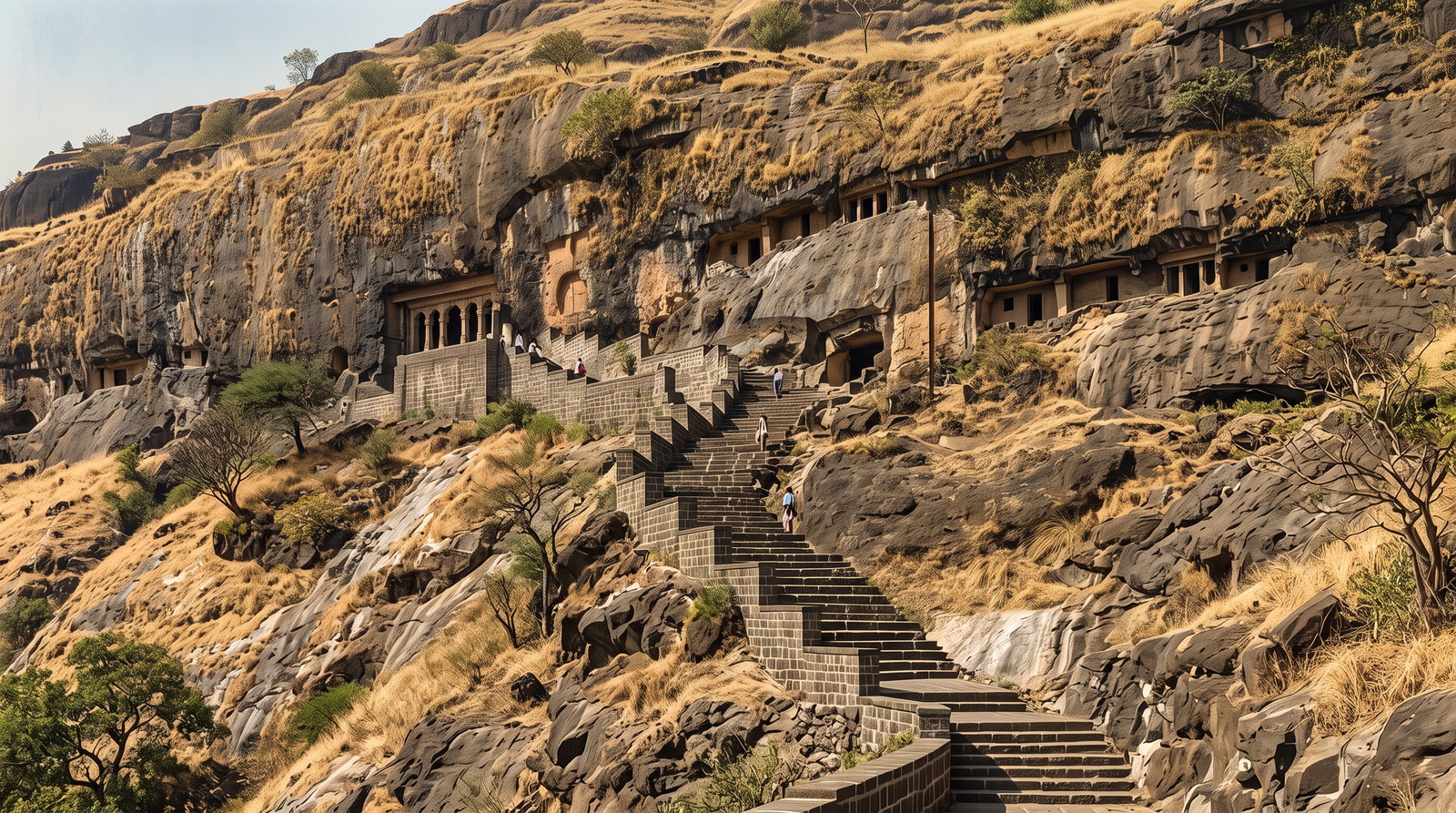
| 6 | Lenyadri — Girijatmaj | A cave shrine within a rock-cut cave complex. Maharashtra Tourism describes an ascent of 307 stone steps. Discuss that effort honestly with older visitors or anyone for whom steps may be difficult; do not assume an alternative access arrangement is available. |
| 7 | Ozar — Vighneshwar/Vighnahar | Known in official tourism material for its Vighneshwar identity and temple architecture. It is near Lenyadri in the Junnar area, but site time and the climb can make the pair a substantial visit day. |
| 8 | Ranjangaon — Mahaganapati | The final shrine in the commonly listed sequence before the return to Morgaon. Its local tradition associates Ganesha with Shiva’s preparation to confront Tripurasura. |
The significance and access notes above are based on Maharashtra Tourism’s destination pages for Siddhatek, Pali, Mahad, Lenyadri, Ozar and Ranjangaon, the Government of India’s Incredible India page for Theur, and the Chinchwad Deosthan Trust’s Mayureshwar account. Mythological details are presented as religious traditions, not independently verifiable history.
A paced six-day Mumbai-origin outline
This sample preserves the customary order and separates the return to Morgaon from the drive back to Mumbai. It avoids treating a map route as a guarantee. The actual assigned garage, Mumbai pickup, chosen road, traffic, diversions, temple queue and stop duration can change each day’s running. For this guide’s conservative itinerary design, aim to keep each day at or below about 400 road kilometres, and closer to 325–350 km where practical. This is a planning target—not a fixed Helios package limit, route guarantee or confirmation. Ask HeliosCabs Operations to review the actual assigned-garage route, expected driving hours, current temple instructions, breaks and overnight plan. If the road leg or total day feels too long once site time is added, split it and add a night.
| Day | Suggested sequence | What to plan around |
|---|---|---|
| 1 | Mumbai → Morgaon | Start with a confirmed pickup point and a realistic departure window. Visit Mayureshwar only if the road arrival and current temple instructions leave suitable time. If it does not fit, keep the evening unhurried and begin with Mayureshwar on Day 2. |
| 2 | Morgaon → Siddhatek → Pali | If not visited on Day 1, begin with Mayureshwar at Morgaon before continuing. This is the most demanding paired travel day in this outline. Check actual road routing and likely darshan time before combining Siddhatek and Pali. If the timing is tight, split them over two days. |
| 3 | Pali → Mahad → Theur | Visit Varadvinayak at Mahad, then continue toward Theur if the route and shrine hours work. Confirm the overnight plan rather than assuming a driver, vehicle or accommodation will be retained. |
| 4 | Theur → Lenyadri → Ozar | Protect time for the Lenyadri ascent and rest after it. Pair Ozar only if the group’s pace and current access allow. Do not plan the day from driving time alone. |
| 5 | Ozar → Ranjangaon → Morgaon | Complete Mahaganapati at Ranjangaon and return to Morgaon for the traditional closing visit. Confirm the local sequence and temple timing with the shrines. |
| 6 | Morgaon → Mumbai | Keep the return as a separate travel day. Do not add an unplanned temple or sightseeing stop without rechecking the total route and agreed service scope. |
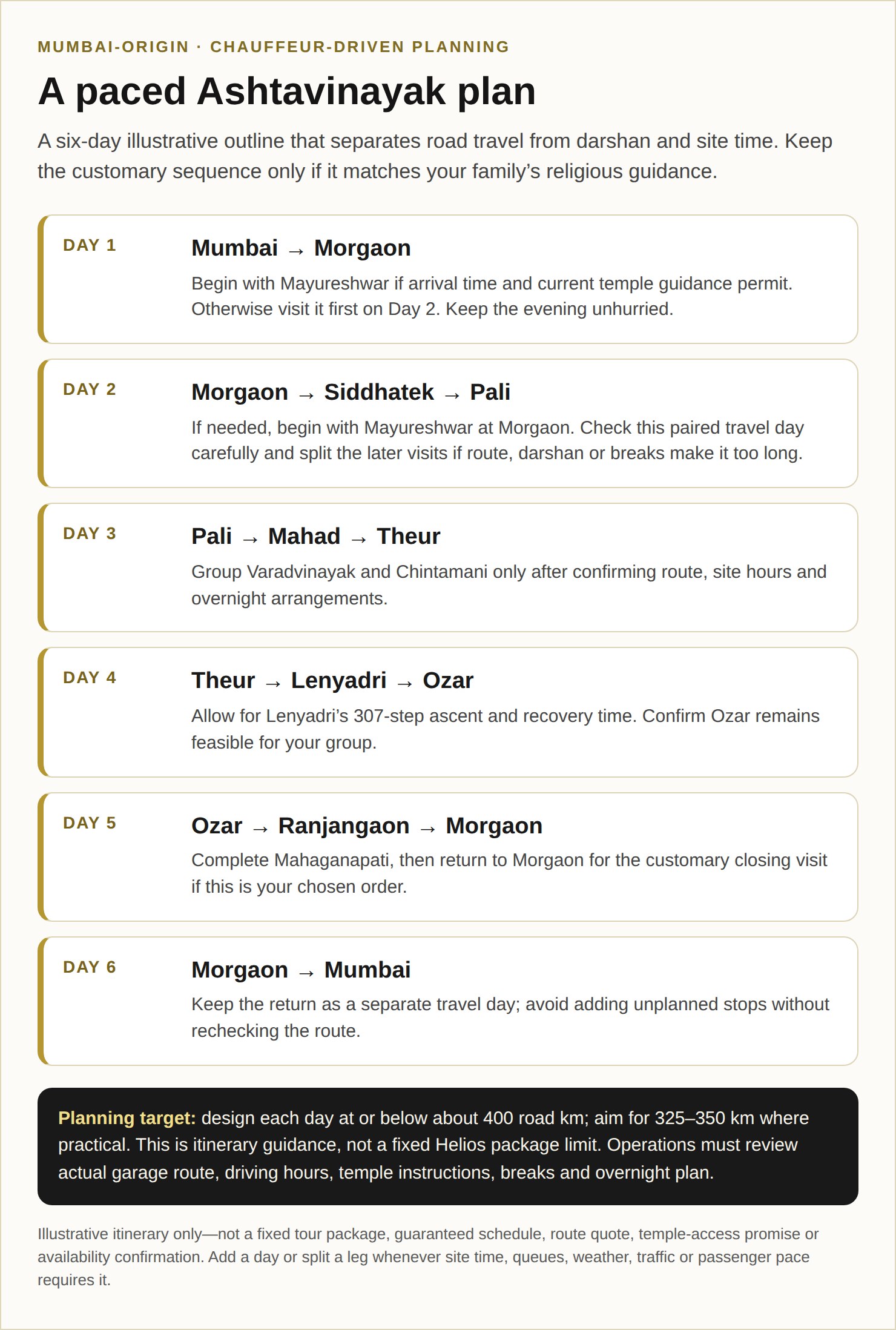
This six-day outline is deliberately paced, but it is not equally easy for every group. Use a seventh day if the Morgaon–Siddhatek–Pali day looks long on the actual map, if a festival or queue may add time, if Lenyadri’s climb needs a slower pace, or if the group prefers more rest. A shorter itinerary should be accepted only after a date-specific route review checks the road distance, driving hours, site hours, breaks and overnight arrangement. An advertised two- or three-day package is not a universal schedule for every family.
What to decide before choosing the order
First, ask whether the group wants the commonly followed devotional sequence or has guidance from its own family or religious source. A route-planning app may suggest a different order; compare it with the religious sequence before adopting it. A road-efficient order is not automatically the same as the devotional order. Do not allow a routing app or chauffeur to silently change a religiously significant sequence.
Next, list fixed commitments: dates, aarti or darshan intentions, accommodation check-in, a required return time, and any onward travel. Temple hours and festival arrangements can change. No article can guarantee a queue length, entry, parking or the time needed for darshan.
Finally, choose the group’s pace. A family with elders, young children, checked luggage or a visitor unfamiliar with local roads may need fewer stops per day. Share mobility needs, but confirm separately whether any physical access assistance or special accommodation is available; this guide does not promise it.
How a chauffeur-driven car can help—and what it does not include by default
For a multi-day yatra, a chauffeur-driven car can be useful when your group wants to travel together from Mumbai, keep the planned stop order in one written brief and ask one operations team to review the road legs and calendar days. It can reduce the planning burden of coordinating multiple local transfers, particularly when the group has bags or a fixed overnight plan. The actual vehicle category should be chosen around passenger count, luggage and comfort preferences, then confirmed by the team. Do not assume that a category name guarantees exact seating or bag fit.
A vehicle request is still separate from temple arrangements. Unless your written quote expressly confirms them, do not assume that darshan or aarti tickets, a guide, accommodation, meals, porter service, temple entry, priority access, waiting, parking, tolls, an English-speaking driver or vehicle continuity across all days are included. HeliosCabs must confirm the route, vehicle, driver/fulfilment, availability, committed calendar days and commercial terms before the enquiry becomes a booking.
For planning reference, read HeliosCabs’ Mumbai outstation car rental page and outstation travel guidance. Road kilometres and billing kilometres may differ because the approved quote can use garage-to-garage calculation. Ask for the written quotation to state the route, committed days, included/excluded components, applicable tax and any toll, parking, night or overnight treatment. Do not calculate a final fare from this guide.
Practical checklist for Indian, NRI and international visitors
Before leaving Mumbai, check current temple information for each stop. Confirm opening and closure notices, darshan/aarti requirements, festival changes, dress expectations, footwear arrangements, phone or photography rules, bag restrictions and lawful vehicle drop/parking options directly with the relevant shrine or official source. The rules may differ from one temple to another.
Keep identity documents, medication, water, sun protection and a small day bag with the group. Do not leave passports, valuables or essential medicines in a vehicle. At Lenyadri, decide honestly whether everyone in the group is comfortable with the stair ascent; check with the temple for current visitor arrangements rather than relying on an old blog or package page. During the monsoon, check weather and road advisories close to departure, and allow more time rather than scheduling around a best-case map estimate.
For an overseas visitor, do not assume that a foreign passport substitutes for any temple-specific registration, ticket or identity rule. Confirm acceptable documents with the relevant temple authority. Also make the enquiry in a language and format the family is comfortable using. HeliosCabs should confirm any language preference for the assigned driver rather than implying that it is guaranteed.
Copy this enquiry brief when requesting a quote
Send HeliosCabs the details below in one message. The clearer the brief, the easier it is for Operations to review route feasibility and ask the next useful question.
Trip: Ashtavinayak Yatra from Mumbai
Travel dates and total calendar days:
Mumbai pickup address and preferred departure window:
Requested order: customary sequence / discuss a different road order
Temples to visit and any fixed darshan or aarti plans:
Passenger count, ages of children, and any mobility considerations:
Luggage count and approximate sizes:
Preferred vehicle category, subject to availability and fit confirmation:
Overnight plan or preferred overnight towns, if already decided:
Mumbai return date and preferred arrival window:
Any onward destination after the yatra:
Questions: verified route km, safe daily driving hours, committed days,
vehicle continuity, driver allowance, taxes, tolls, parking, waiting,
overnight treatment and what is included/excluded in the quote
Contact number and preferred follow-up channel:
Use the Mumbai outstation enquiry page or call +91 84518 84899. Ask for the confirmed itinerary and written quote before making non-refundable temple, hotel or onward-travel plans. An enquiry is not a booking confirmation.
Common questions
What is the traditional Ashtavinayak order?
The commonly followed sequence is Morgaon, Siddhatek, Pali, Mahad, Theur, Lenyadri, Ozar and Ranjangaon, followed by a return to Morgaon. Maharashtra Tourism identifies Morgaon as the first and last stop. If your family follows a particular religious instruction, verify the order with its trusted source.
How many days should I allow from Mumbai?
Use the six-day outline above as a starting point, then add a day if any road leg, darshan queue, festival condition or rest need makes the schedule too full. Some operators advertise shorter packages, but their route, pace, inclusions and driving conditions may differ. A safe plan must be checked for your own pickup, date, stops and group.
Can the full yatra be completed in three days?
A three-day trip is advertised by some providers, but that does not establish that it is right for every group or date. Before choosing it, have Operations verify each day’s route distance and driving hours, then account for breaks, darshan time, opening hours, the Lenyadri steps, overnight logistics and return to Mumbai. If those checks do not fit, add a day rather than relying on optimistic assumptions.
Does a chauffeur booking include temple tickets or special darshan?
Do not assume so. Temple services and vehicle services are separate. Ask the relevant temple authority about tickets, aarti, entry and visitor rules, and ask HeliosCabs to state the confirmed vehicle-service inclusions in writing.
Can the driver wait while the family visits each shrine?
Waiting, parking, vehicle continuity and overnight duty require explicit confirmation in the quote. A temple visit may take longer than expected, especially on busy dates. Build a buffer and do not assume that parking at a particular entrance is available.
Is Lenyadri suitable for every traveller?
Maharashtra Tourism describes a 307-step ascent to Girijatmaj. Anyone uncertain about steps, heat or exertion should assess the visit with their group and contact the site about current access arrangements. Do not assume that an alternative ascent or assistance is available.
Plan the pilgrimage around the people, not only the map
An Ashtavinayak journey combines a religious sequence with long road legs and very different site visits. Decide what order matters to your group, allow enough calendar days, and keep the return to Mumbai separate from the final shrine wherever possible. Then request a date-specific, chauffeur-driven plan that states what HeliosCabs has actually confirmed.
Planning an Ashtavinayak Yatra from Mumbai? Share your dates, preferred sequence, passenger and luggage details, temple commitments and desired pace through the Mumbai outstation page. For related Maharashtra pilgrimage planning, see HeliosCabs’ guides to Mumbai–Shirdi and Mumbai–Nashik–Trimbakeshwar. Route, vehicle, availability, waiting, access and quote remain subject to written confirmation.
Planning an Ashtavinayak Yatra from Mumbai?
Share your dates, preferred temple sequence, passenger and luggage details, fixed darshan plans and desired pace. Ask HeliosCabs Operations to review the route and provide written vehicle and outstation terms. An enquiry is not a booking confirmation.
Sources and further reading
- Maharashtra Tourism: Morgaon
- Chinchwad Deosthan Trust: About Shri Mayureshwar Temple
- Maharashtra Tourism: Siddhatek
- Maharashtra Tourism: Pali
- Maharashtra Tourism: Mahad
- Incredible India: Ashtavinayak Temple, Theur
- Maharashtra Tourism: Lenyadri
- Maharashtra Tourism: Ozar
- Maharashtra Tourism: Ranjangaon
- Ashtavinayak route sequence reference
Share this article:

[…] and daily stages requiring their own confirmation. For existing destination detail, use the live Ashtavinayak guide, Mumbai–Shirdi guide or Mumbai–Nashik–Trimbakeshwar guide; this article does not repeat those […]
[…] dependencies are distinct from this Ratnagiri plan. For a separate pilgrimage circuit, the live Ashtavinayak Yatra from Mumbai guide may help you compare trip intent. General service details are available under Mumbai outstation […]
[…] this Kolhapur plan sits within the Maharashtra pilgrimage circuits from Mumbai guide. The live Ashtavinayak Yatra guide covers a different pilgrimage and is not a substitute for checking this […]